Skills You Learn During a Partial Hospitalization Program (PHP) in Burlington

When you are not in a good place mentally and behavior-wise, there are nights when peaceful sleep becomes a far-fetched idea and mornings when getting out of bed feels impossible. That’s the time when you need help that can get you out of these battles.
But there are some shocking stats about a sad reality. SAMHSA says that 1 in 5 adolescents went through a major depressive episode in 2023. But what’s sad is that 40% of them never received any treatment or help.
Behind these numbers could be a young person slowly losing hope and their dreams for life because of a mental health condition. Or a grown adult with responsibilities slipping away and losing their true self to addiction.
But there’s still hope. CDC reports that drug overdose deaths dropped by 27% in the US in 2024 compared to 2023. And that positive change shows that when treatment and prevention are taken seriously, lives can be saved.
Progress is possible when people are given the care they need at the right time, and that’s where plans like a partial hospitalization program (PHP) in Burlington fit in.
They don’t take you away from your life; they give you daily structure and real skills to cope with what you’re facing. Keep reading to know what PHP teaches you and how it gets you out of the ditches.
Why Skill-Based Treatment During a Partial Hospitalization Program (PHP) in Burlington Matters
Skill-based treatment during a partial hospitalization program (PHP) in Burlington gives you something to reach for in the very moment symptoms strike.
Instead of being left with only insight about why you feel a certain way, you get clear steps.
For instance, you might learn a breathing technique when panic rises or a grounding exercise to dodge the cravings.
And since you’re in a day treatment almost every day of the week, what you learn sticks and weaves well into your day.
The way a partial hospitalization program (PHP) in Burlington is structured is of the essence here.
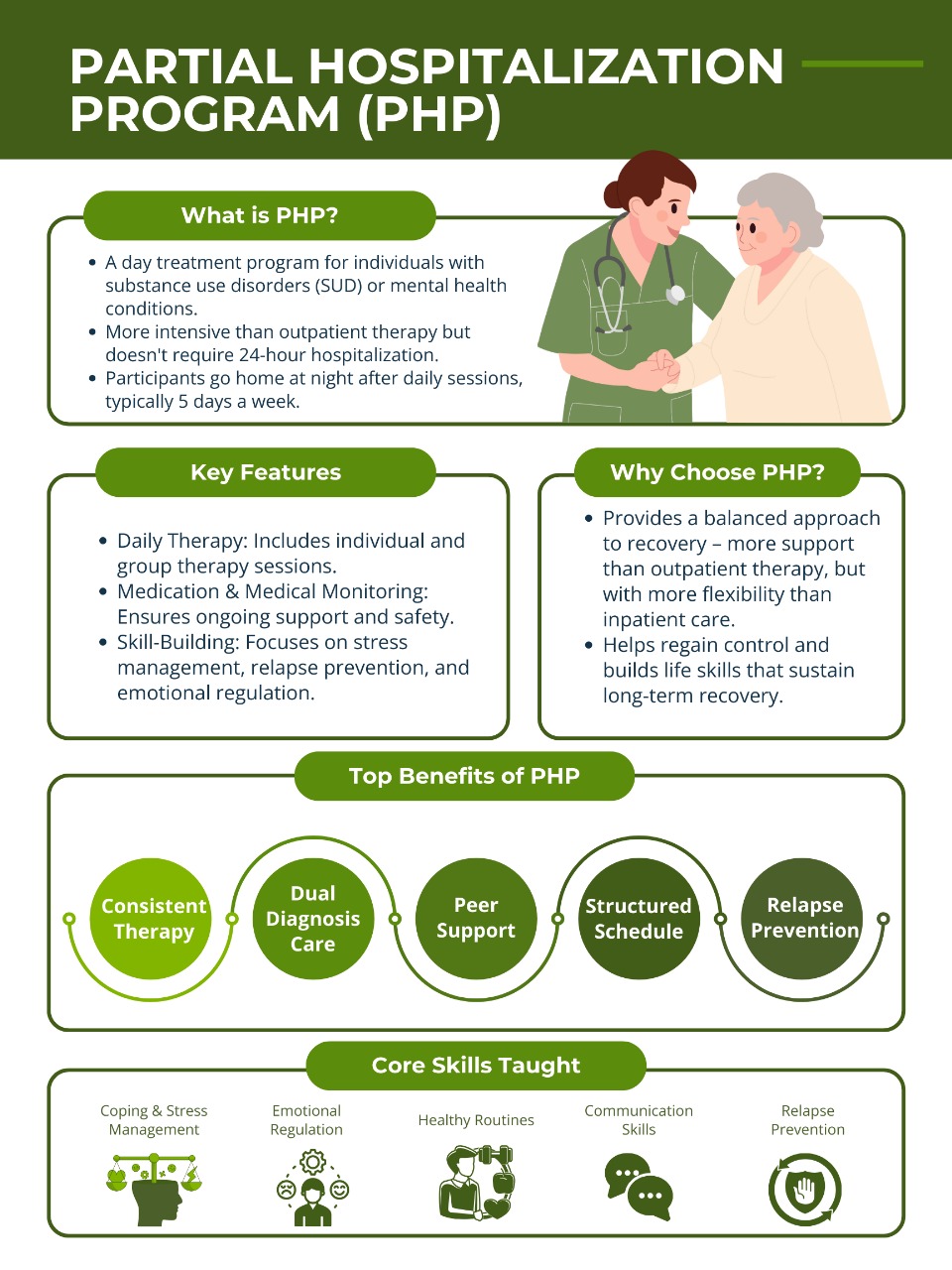
You learn skills in a safe setting during the day and get to try them at home that same evening to keep tabs on your progress. If something feels hard or doesn’t work, you bring it back the next day, and your physician adjusts it accordingly. This cycle of practice and feedback helps you build practical habits for when you need them the most.
Core Skills You Practice During a Partial Hospitalization Program (PHP) in Burlington
A partial hospitalization program (PHP) in Burlington is powerful because of how immediate it feels. You learn the following things during your time at a center and don’t have to wait weeks to find out if something helps:
CBT Thought Skills
Learning to work with your thoughts instead of feeling trapped by them is crucial to your healing. Therefore, you practice noticing automatic thoughts as they come in CBT (Cognitive Behavioral Therapy (CBT)).
For example, if your thoughts go like “I’ll never get better” or “I can’t handle this,” you test them instead of letting those statements run unchecked. Is this thought a fact, or is it an old habit of your mind?
After identifying these distortions during a partial hospitalization program (PHP) in Burlington, you build balanced replacements. You adopt thoughts that are realistic and less punishing. For example, “I’m struggling right now, but I’m working on it.” These shifts give you breathing room, and you’ll have a set of thought tools you can use anywhere when hopelessness threatens to take over.
Behavioral Activation
Depression can make you want to shut down, but behavioral activation teaches you to restart your energy. You don’t wait to feel motivated, you choose tasks (like a 5-minute walk or calling a friend) and follow through to tell yourself you can do it. These intentional actions break the cycle of inactivity that depression feeds on.
Also, during PHP, you plan these activities daily and adjust based on what’s realistic for you.
Naturally, stacking one small action on top of another builds momentum, and you reconnect with life in ways that feel achievable.
DBT Distress Tolerance
Crisis is inevitable when you’re facing dependence or mental health problems; sometimes, panic, urges, and emotions overwhelm you so fast you feel like you’ll break. That’s where Dialectical Behavior Therapy (DBT) distress tolerance tools work.
During a partial hospitalization program (PHP) in Burlington, you learn paced breathing, grounding, or TIP skills (temperature change, intense exercise, paced breathing, progressive relaxation).
These skills help you ride it out safely until the intensity passes. You’ll also practice grounding strategies where you use your senses to anchor yourself to the present when your mind wants to spiral.
DBT Emotion Regulation
Emotions can spike out of nowhere when there’s an addiction or weak mental health in the picture. Therefore, you need emotion regulation skills to notice the early signs before the storm hits. You learn to name your emotions and track body cues like tension or a racing heartbeat during PHP. Then, you plan responses that don’t add fuel to the fire.
For example, instead of snapping when you feel irritation building, you could use a self-soothing activity and take a few moments before reacting. Since you rehearse these skills almost every day, you naturally act differently in situations that would tick you off before learning emotional regulation.
Sleep And Routine Stabilization
Poor sleep can undo even the best treatment progress, so PHP places a strong focus on stabilizing your sleep and daily routines. The physicians at Forrest Health help you set consistent wake times and calming wind-down habits.
You also build a routine that makes your life feel more predictable, and that structure can be healing. It means that instead of chaotic days that make you vulnerable to cravings or mood swings, you decide how to spend your time.
Regain Control Over Your Life. Now!
We know how hard it is to keep carrying pain that others can’t see. The endless fight with your thoughts and the fear that tomorrow might look just like today can make you feel invisible and worn down.
But you are not invisible here because Forrest Behavioral Health sees your struggles. We believe you deserve care that doesn’t give up on you, and our team is here to stand with you in the middle of the hard days. You don’t have to fight this battle by yourself anymore. Call us at (781) 570-5781 or email info@forrestbh.com and let us help you find your way forward.