

How Depression Affects Daily Functioning in Adults (And When to Seek Help)
The historic towns of Concord and Lexington are known for their picturesque communities and strong family foundations. Yet, beneath the surface of busy school runs and community events, many adults are quietly carrying a crushing weight.
Depression doesn’t always look like an inability to get out of bed; often, it is a slow, silent fade of energy and joy. Despite living in a state with excellent healthcare, over 1.1 million residents try to push through this exhaustion alone, mistaking clinical depression for temporary stress.
Forrest Behavioral Health offers a compassionate, clinical alternative to suffering in silence. We provide the trauma-informed care necessary to understand how depression affects daily functioning in adults and precisely when to seek help. Read on to find out how.
The Cognitive Toll of the “Slow Fade”
Clinical depression is deeply misunderstood. It is not simply a matter of feeling sad about a specific event. It is a complex neurological condition that fundamentally alters how your brain processes information, energy, and emotion. The descent is rarely sudden. It is a slow fade that erodes your cognitive function day by day.
Brain Fog and Indecision
One of the most crushing symptoms of adult depression is the impact on executive functioning – meaning your ability to get stuff done.
It rewires your prefrontal cortex, which is responsible for decision-making and focus. When you are caught in a depressive episode, your neurotransmitter-starged brain fails to find the power to compute, creating a pervasive “brain fog” that makes simple, everyday tasks feel monumental.
The little things look like the end of the world. Answering a basic work email, deciding what groceries to buy, or figuring out what to make for dinner become gigantic tasks. You stare at your computer screen or your pantry, completely paralyzed by indecision.
This cognitive exhaustion drains your productivity, leading to missed deadlines and piling responsibilities that only further fuel your sense of failure.
The Loss of Joy (Anhedonia)
Depression sucks the fun out of everything, like a joy leech stuck to your brain. Neighborhood gathering, or a child’s soccer game, all feel like chores more than fun. The world turns gray.
It is not that you are actively crying or grieving; it is that your capacity for joy has been biologically muted.
This absence of feeling is terrifying. It convinces you that you will never enjoy your life again, making the prospect of getting out of bed feel entirely pointless.
The Ripple Effect on the Family System
Depression does not happen in a vacuum. It is a condition that deeply impacts the entire household. When an adult is struggling, the emotional temperature of the entire home changes, often leading to confusion and resentment among family members.
Irritability vs. Sadness
When your nervous system is depleted, and your brain is struggling to function, you just can’t tolerate stuff.
A spilled glass of milk or a minor disagreement with your partner makes you want to throw up your hands. High-functioning professionals often hold it together all day at work, only to unleash their irritability on the people they love the most behind closed doors.
This creates a toxic cycle of snapping, followed immediately by intense remorse.
The Guilt of “Not Being Present”
This dynamic leads directly to another heavy burden. We validate the profound guilt parents and partners feel when they are physically in the room but emotionally completely detached from their loved ones. You are sitting on the couch while your children play, but your mind is a million miles away, trapped in a loop of negative thoughts or profound numbness.
You see your family, you know you love them, but you cannot force yourself to actually connect with them. This emotional absence is painful for a spouse to witness and devastating for the individual experiencing it. The guilt of failing to be a present, engaged partner or parent often becomes the heaviest weight of the entire depressive episode.
When “Pushing Through” Becomes Dangerous
In Massachusetts, there is a strong cultural expectation to just keep going. We are taught to put our heads down and push through the fatigue. However, pushing through untreated clinical depression is not resilience. It is a dangerous strategy that often leads to secondary crises.
The Limits of Self-Medicating
When the internal emptiness becomes too loud, the human brain naturally seeks a volume knob. We acknowledge how often adults turn to a few glasses of wine at night to numb the emptiness. Alcohol or prescription medications offer a temporary, artificial spike in dopamine. For a few hours, the anxiety quiets down, and the gray fog lifts just enough to fall asleep.
However, we know exactly how quickly this can spiral into a co-occurring disorder. Alcohol is a central nervous system depressant. While it might numb the pain tonight, it chemically deepens the depression tomorrow morning. You wake up feeling more depleted, requiring more alcohol the next night just to reach baseline. This self-medication cycle accelerates the physical and mental collapse, turning a mood disorder into a severe dual-diagnosis emergency.
Identifying the Tipping Point
You must know how to identify the clear signs that it is time to seek intensive help. If your daily functioning is visibly declining, you have reached the tipping point.
This includes letting basic hygiene slip, completely isolating from friends, canceling plans consistently, or calling out of work repeatedly because you simply cannot face the day.
Comprehensive Care for Lasting Relief
You do not have to accept the slow fade as your permanent reality. At Forrest Behavioral Health, we offer the intensive, sophisticated care required to pull you out of the fog and restore your vitality.
Treating the Whole Person
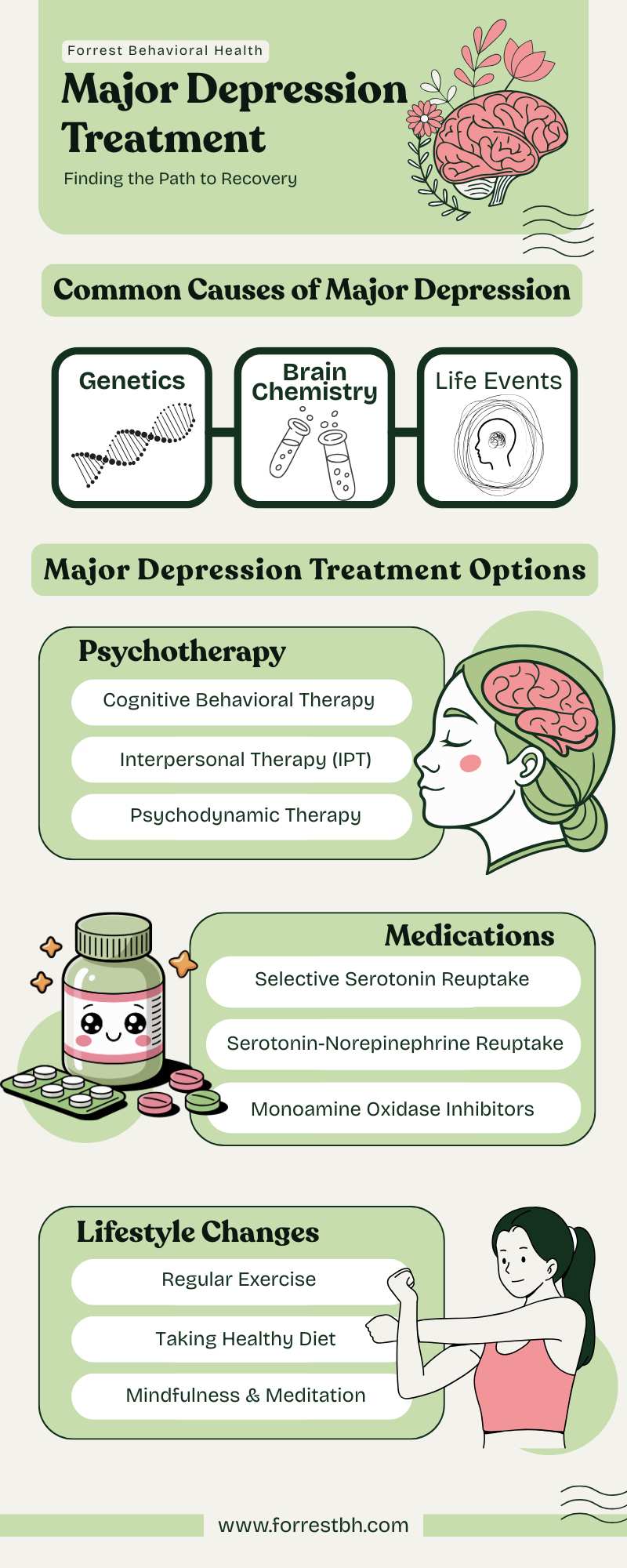
We explain how our clinicians utilize a combination of advanced psychiatric medication management and robust cognitive therapies to lift the heavy fog of depression.
We do not just hand you a prescription and send you on your way. Our medical team works to stabilize your brain chemistry safely, providing a solid floor for you to stand on.
Claim Your Future: The Next Step in Your Recovery
You do not have to live in the gray. The crushing exhaustion and the silent fade of your energy do not have to be a life sentence. A vibrant, deeply connected, and joyful life is entirely within your reach, and the highly personalized support you deserve is located right here in Bedford.
Reach out to our clinical team for a compassionate assessment. We will listen to your story, warts and all, evaluate your specific needs, and build a targeted plan to help you begin rebuilding your energy and finding your joy.
Visit forrestbh.com or call (781) 570-5781 to take the next step. Let us help you find the light again.