

What Happens After IOP? Continuing Care Options in Illinois
An intensive outpatient treatment for mental health is meant to make you feel encouraged instead of pressured and supported instead of restricted. It follows a structured path where you visit the treatment center 3-5 days a week for around 3-hour sessions for 12 weeks on average.
Naturally, these sessions become a part of your routine, and you start depending on them for clarity and support regarding whatever is bothering you. However, after a certain period, doctors in Illinois bump your IOP treatment up or down, depending on how well you’re doing. And once this routine ends, you can feel confused or awkward about life outside. Therefore, understanding what happens after IOP is important so you always have a direction.
Let’s discuss the continuing care options in Illinois after IOP, so you understand what might come next. Stick around to plan your journey ahead.
What Happens After IOP?
Mental health experts recommend IOP when someone needs consistent support without 24-hour supervision. Also, if one’s condition cannot be managed with standard therapy, the treatment center will ask them to visit multiple times a week to improve outcomes.
It’s mostly preferred for depression, anxiety, PTSD, and bipolar disorder treatment as these conditions require more structured treatment.
That said, once you complete the IOP of almost 12 weeks, here are the continuing care options you can avail in Illinois:
Standard Outpatient Therapy
Intensive outpatient treatment for mental health builds a solid foundation, and continuing standard therapy after it protects that foundation. Put simply, even if your IOP showed impressive results, stopping treatment right after it can undo some of the progress. Therefore, mental health treatment centers recommend you continue meeting with a therapist.
Your therapy sessions are typically 45-60 minutes to discuss your current feelings and challenges, so the expert can lead you to a safe routine.
Thankfully, you aren’t faced with packed schedules or group sessions in standard outpatient therapy and can take it like your me time. If you have had a bad week or managing responsibilities is feeling difficult, you discuss that with the expert and follow their instructions.
Since there are always triggers and stress that can affect your mental health, therapy gives you a consistent space to process all that. That said, if you are leaving IOP feeling like you have things under control, this is the best time to start outpatient therapy because you have momentum. Having a professional in your corner means you always have a direction!
Individual Therapy and Psychiatric Care
An intensive outpatient program combines therapy, structure, clinical support, and community. While that combination is powerful, it ends with IOP and could leave you confused. For example, if you’re managing a particular diagnosis like depression, PTSD, or bipolar disorder, losing a supportive ecosystem can make things dangerous.
Therefore, you need individual therapy as its solid replacement. In simple words, this therapy is a focused relationship with a licensed therapist who knows your diagnosis and understands your history.
It’s worth mentioning that some of the most important breakthroughs in recovery happen at this stage because the noise of intensive treatment is gone. At this point, you can let your guard down and reach the root cause of your problems with an expert’s help.
Moreover, psychiatric care after IOP in Illinois is equally non-negotiable if medication is part of your treatment. You will stay in touch with a psychiatrist so they can maintain your prescriptions, monitor how different meds are working, and adjust them based on your improvement.
Sober Living
You can do everything right inside IOP, but if you return to a chaotic or unsupportive home, you’ll still struggle. Also, sometimes your family is among the contributing factors of your condition, and going back to them right after IOP is never smart.
Fortunately, you can depend on sober living in this situation. Sober living is for people in recovery who need a stable and substance-free environment for a certain period.
It’ll mostly be a shared residential setting where everyone is in recovery and committed to staying that way. It works much like other shared living spaces, where you pay rent, follow house rules, and contribute to the household. The main difference here, though, is that everyone is committed to keeping the environment trigger-free.
From this shared space, you can go to work or school and move through daily life normally. This living setting will create a bridge between you and a potentially harmful home environment. Here, you have the time and stability to build a new routine and practice your coping skills before taking these skills home.
Partial Hospitalization Program (PHP) (If You Need More, Not Less)
Sure, IOP is an incredible treatment model, but sometimes it doesn’t suffice for extreme situations. For example, if your trauma or depression wouldn’t budge despite multiple weekly visits to the treatment center, you’ll be recommended to enter a stricter program. During partial hospitalization, you spend 6-8 hours each day at a treatment center and return home every night.
PHP, also called day treatment, is more structured than IOP and keeps you engaged in individual therapy, psychiatric appointments, and structured skills.
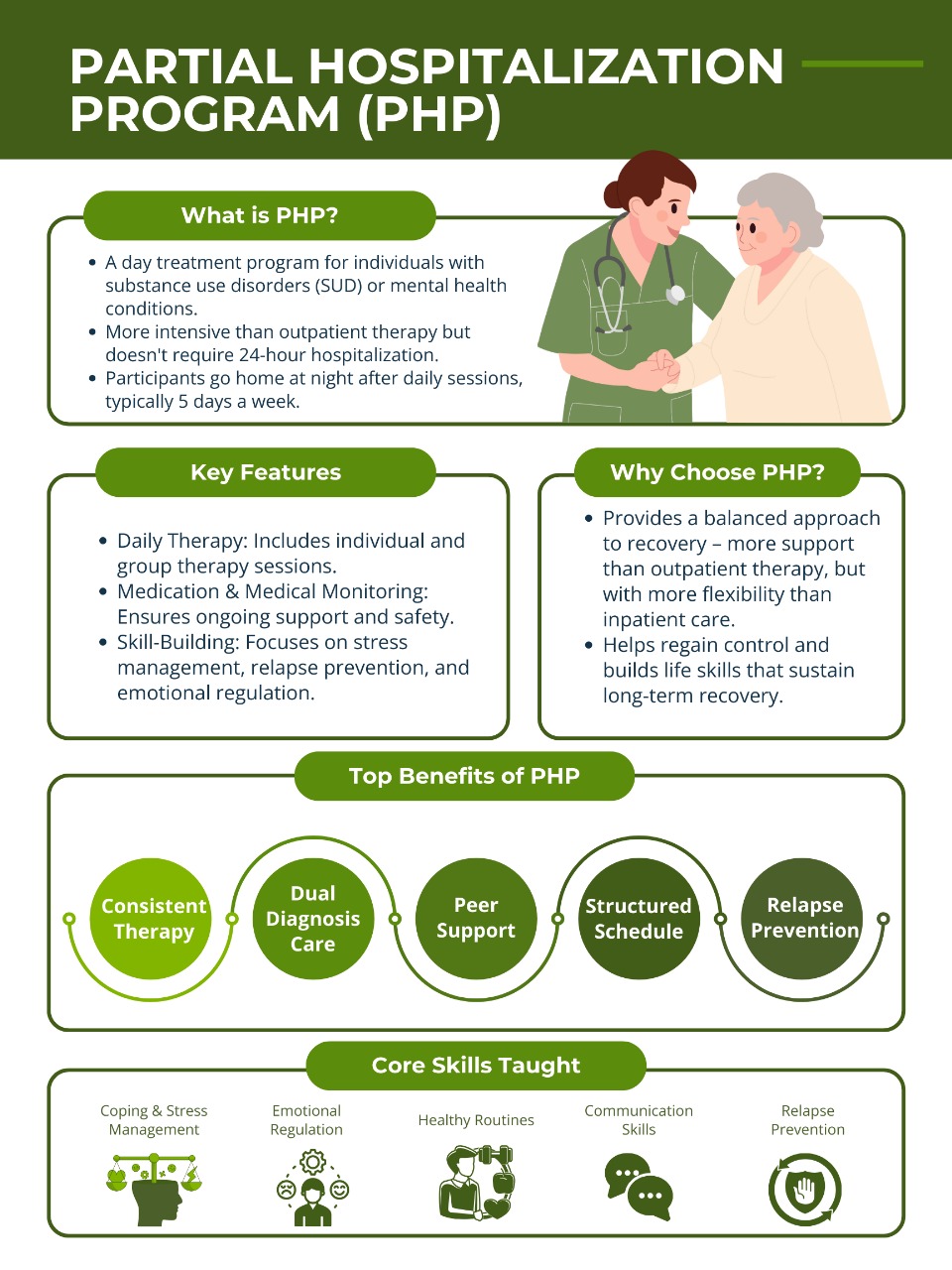
Then, unlike an inpatient stay, you return home at night and stay in touch with your everyday life. The extended daily hours are crucial because conditions like severe depression or acute trauma do not respond to light-touch treatment. They need more consistency and close psychiatric oversight, which PHP provides.
Alumni Programs
Staying in touch with others who have faced (or are facing) the same struggles as you can be comforting. Building a safe community is genuinely therapeutic after treatment ends because it prevents the isolating feeling.
Most treatment centers offer these programs to graduates, where everyone is expected to maintain group check-ins and participate in community events. This village is useful because long-term recovery is not just about the clinical work; it is heavily shaped by who you are surrounded by. On the other hand, isolation after IOP can trigger a relapse because you lack accountability. Therefore, alumni programs directly counter give you a community that checks in on you and reminds you that you are not navigating this alone.
Better Life is Ahead
An intensive outpatient program can set you up for long-term stability. And when you enter these continuing care options after it, your recovery efforts show even better results. If you want to see your efforts pay off, contact Forrest Behavioral Health, and we’ll build a sustainable recovery plan so you can live a better life.