

When Alcohol Keeps Repeating the Same Day: Outpatient Treatment in Massachusetts
Time, we’re told, moves in one direction. Forward. Inexorable. Addiction, however, operates on a different temporal plane entirely. It loops back on itself. Each day collapsing into the one before it. Each promise to stop dissolving into the familiar ritual of another drink. The glass in your hand becomes both your present and your future. A recursive nightmare where cause and effect blur into a single, suffocating moment.
What if we told you there was a way to break the loop?
In Massachusetts, thousands confront this very paradox daily. They wake to obligations while simultaneously drowning in a dependency that threatens to unravel everything. Conventional inpatient care involves a decision: to abandon your life to preserve it. Even so, in the eyes of many, this dichotomy is not only impractical but also impossible. The mortgage doesn’t pause. The children have to be picked up at school. The world, unmindful of your personal war, goes on revolving like a black hole.
This article will explain the channels of choice in the outpatient program in Massachusetts, the evidence-driven methods that can make you well again, and how you can break the cycle without disrupting the life that you have created.
What Is Outpatient Treatment for Alcohol Addiction?
Imagine a structure that exists in two places at once. You’re in treatment, but you’re also at home. You’re receiving professional care, but you’re still going to work. This isn’t a paradox. It’s the fundamental architecture of outpatient treatment.
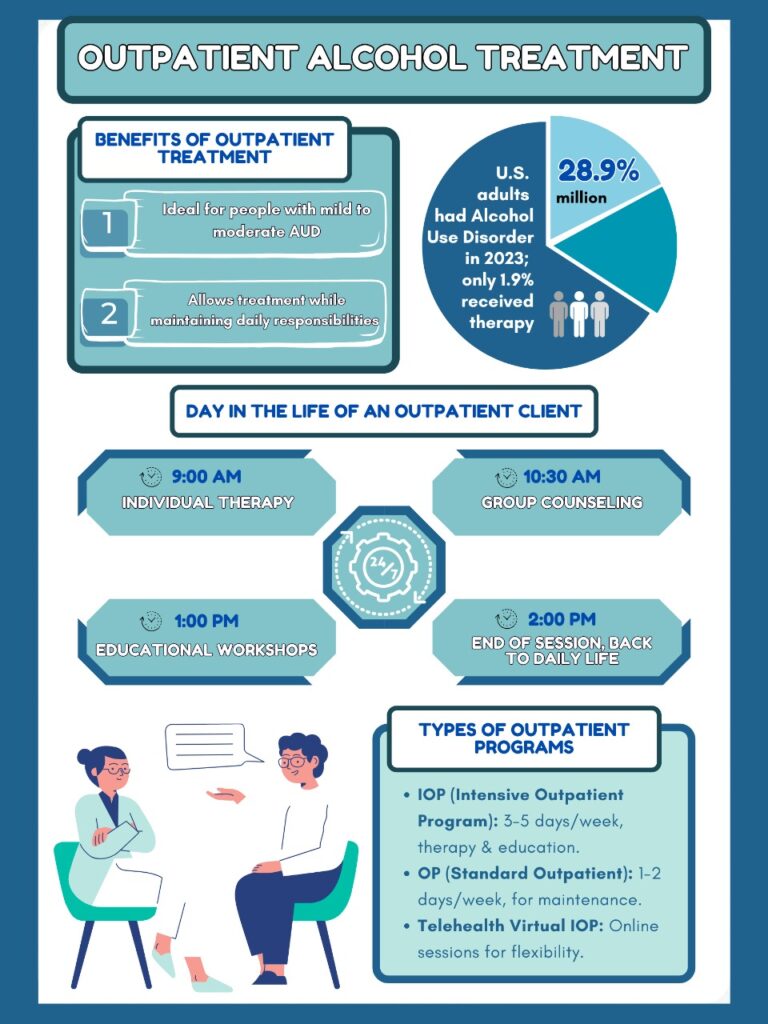
Outpatient alcohol treatment is a type of rehabilitation that enables patients to be treated therapeutically without leaving their homes and their daily routine. Unlike residential or inpatient programs, outpatient care works on different principles. You are not expected to move to a treatment facility for weeks or months. You do not need to be totally out of your life to recover. All it requires is the right support delivered at the right intervals.
How Outpatient Treatment Fits Into Daily Life
The model generally includes regular visits to individual therapy, group therapy, medical supervision, and psychiatric assistance that take place a few times a week. The intensity can vary. There are treatment programs that need twenty hours per week; some only a few. The structure will vary based on the level of addiction, possible dual diagnosis, and your home environment.
What distinguishes outpatient treatment isn’t merely where it takes place but how it functions within the temporal reality of your existence. You have a therapy session in the morning and go to work. In the evening, you engage in group counseling, and then you get home to your family. The treatment weaves itself into the fabric of ordinary time. Creating a hybrid space where the recovery and the real life are not two dimensions but a mutual inclusion.
Clinical Components and Therapeutic Methods
The clinical components are evidence-based and holistic: cognitive behavioral therapy to change the destructive thoughts. Motivational interviewing techniques to find encouragement to stick to change.
In addition, the cravings and withdrawal symptoms can be overcome by the medication-only method. Finally, relapse prevention techniques may assist you in overcoming the inevitability of vulnerability.
Simply put, each of the parts has a specific role within the larger healing process.
Why Context Matters in Outpatient Recovery
Perhaps the most crucial aspect is this: outpatient treatment operates on the principle that context matters. You’re not recovering in isolation, in some sterile environment divorced from triggers and stressors. You’re recovering in the actual conditions of your life. This means you’re learning to navigate sobriety in the very environment where you’ll need to maintain it.
The skills you develop aren’t theoretical. They’re immediately applicable, tested in real-time against the pressures and patterns that contributed to your addiction in the first place.
Levels of Outpatient Care in Massachusetts
In Massachusetts, the outpatient programs are of two types, namely outpatient (OP) and intensive outpatient (IOP) programs, as well as partial hospitalization programs (PHP). Each of them provides increasing care levels without the necessity to remain at home daily.
The correct level will be based on your circumstances, clinical needs, and professional judgment of where you are likely to be most successful.
Understanding The 5 Stages Of The Addiction Recovery Process
Healing does not happen in one instance. It’s a process; one step leads to another, and every move has to take its own kind of courage.
Stage 1: Precontemplation. You are not yet aware of the problem, or you are not prepared to accept it. The addiction is present, but the realization has not solidified. This is the prelude to the story itself.
Stage 2: Contemplation. The recognition arrives. You know there is something wrong; you are balancing the pros of going on with the challenge of quitting. It is a time of making decision between inaction and action.
Stage 3: Preparation. Decision becomes a plan. You’re gathering resources, researching options, and setting a date. The abstract commitment begins to take concrete form. You’re building the launchpad.
Stage 4: Action. This is where transformation occurs. You enter treatment, you stop drinking, and you implement the strategies you’ve learned. The blueprints become reality. The work is intensive, demanding, and often uncomfortable. But it’s also where change actually happens.
Stage 5: Maintenance. Healing is a long-term practice and not an acute treatment. You are strengthening new patterns, working the triggers, and creating a life that will help you to be sober. This stage doesn’t end. It evolves into your new baseline.
It takes most individuals through these phases several times before the recovery sets in. That’s not failure. That’s the process. Every single time you learn something. You get to see another part of what you should know about yourself and your position with alcohol. The trail is not straight, but still it is making progress even where it appears to go back on itself.
Why Choose Forrest Behavioral Health for Sobriety
Every recovery story needs the right framework to support it. The sole mantra of Forrest Behavioral Health is evidence-based treatment and honest compassion. In Massachusetts, you can build your life without destroying it first with our outpatient programs, which combine clinical experience and a flexible schedule.
Individual therapy. Group support. Medical oversight. Relapse prevention. Each component is precisely calibrated to your specific needs. The question isn’t whether recovery is possible. It’s whether you’re ready to begin. Forrest Behavioral Health provides the structure. You provide the will. Together, you construct something that lasts!