

PHP vs IOP: Which Mental Health Program Is Right for You?
You’re taking traditional weekly therapy, but it isn’t giving you enough support. You don’t feel like you need to stay in a hospital either. If that’s where you are, you may have come across two terms: Partial Hospitalization Program (PHP) and Intensive Outpatient Program (IOP).
Both offer more support than weekly therapy, but they’re different. The right choice depends on your symptoms, daily life, support system, and how much support you need.
According to SAMHSA, PHP and IOP are more intensive forms of outpatient care that can include individual treatment, group sessions, and coping-skills education.
If you’re searching for the best mental health treatment providers or looking for help near me for mental health, understanding the difference between PHP and IOP can help you make a more informed decision.
You May Need More Support Than Weekly Therapy
Traditional outpatient therapy can be helpful for many, but sometimes meeting with a therapist once a week isn’t enough.
Your symptoms may be making it harder to work, go to school, maintain relationships, sleep, or handle daily tasks. You may also be leaving inpatient treatment and need extra support as you return to your normal routine.
That’s where PHP and IOP can help!
Both provide structured treatment while allowing you to return home rather than staying at a treatment facility overnight.
PHP vs. IOP: What’s the Difference?
The simplest way to understand the difference is time and level of support.
- Partial Hospitalization Program (PHP): Generally provides a higher level of outpatient care, with several hours of treatment on most weekdays. It offers more structure while you continue living at home.
- Intensive Outpatient Program (IOP): Provides regular treatment but usually involves fewer hours. This gives you more time for work, school, family, and other responsibilities.
Both programs include individual therapy, group therapy, skills training, medication management, and care coordination. Services and schedules vary by provider.
A Quick Comparison
PHP | IOP | |
Level of Support | More intensive | Less intensive |
Time Commitment | More hours | Fewer hours |
Structure | Highly structured | More flexible |
Living Arrangement | At home | At home |
Common Role | Stabilization or step-down care | Step-down or support beyond weekly therapy |
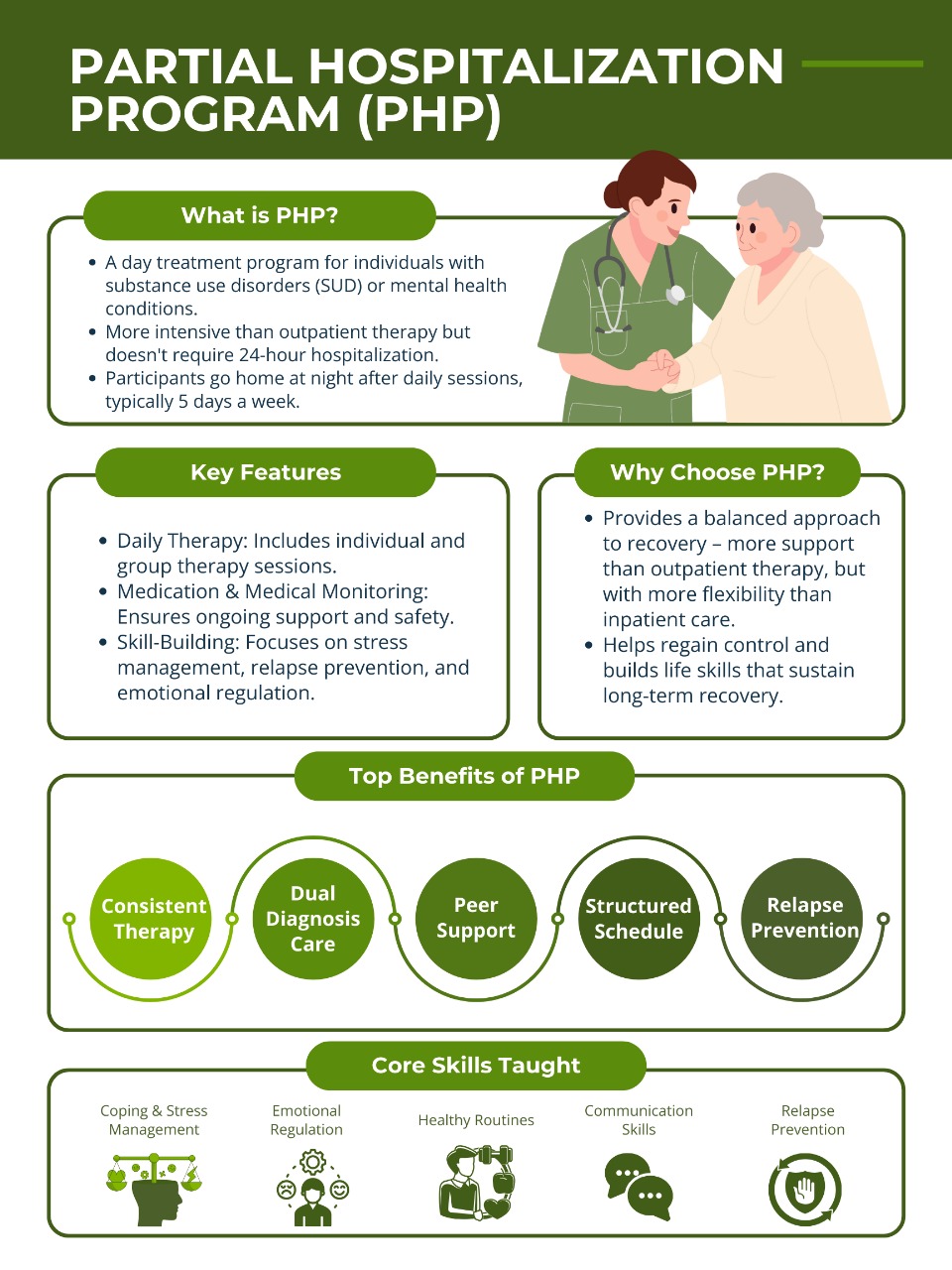
What Does PHP Look Like?
PHP provides a structured schedule with different types of treatments, such as:
- Group therapy
- Individual therapy
- Mental health education
- Coping-skills practice
- Medication management when appropriate
- Regular clinical check-ins
- Treatment planning
This level of support can be helpful when symptoms make daily life harder to manage. You return home after treatment, so you can practice the skills you learn in your everyday life.
What Does IOP Look Like?
IOP provides regular treatment but offers more flexibility than PHP. You may attend sessions several days a week while continuing with work, school, family, and other daily responsibilities.
It can be a good option if you need more support than weekly therapy but can still manage much of your daily life on your own. IOP can also help you gradually move from PHP to a less structured routine as you begin to feel better.
When Might PHP Be a Better Fit?
PHP may be a good fit if you need regular support but don’t need 24-hour inpatient care. You can consider it when:
- Symptoms are making daily life difficult.
- Weekly therapy isn’t enough.
- You need a more structured treatment schedule.
- You’re moving from inpatient care to outpatient treatment.
- You need regular support from mental health professionals.
- You want to build skills to manage your symptoms better.
When Might IOP Be a Better Fit?
IOP may be a good fit if you need regular treatment but can manage more of your daily life outside the program.
It may work well if:
- You need more support than weekly therapy.
- You can manage some time on your own between sessions.
- You want to continue working or going to school.
- You’re moving from PHP to a less structured program.
- You’re working on maintaining your progress as you return to your normal routine.
Can You Move Between PHP and IOP?
Yes. Your level of treatment can change as your needs change.
Someone may start with PHP because they need more support and later move to IOP as their symptoms improve. From there, they may transition to regular outpatient therapy or another type of ongoing care.
The opposite can happen too. If someone in IOP needs more support, their treatment team may recommend going for PHP for more structured care.
What Makes the Best Mental Health Treatment Providers?
Finding the best mental health treatment providers isn’t just about choosing the highest-rated facility. It’s also about finding a provider that fits your needs.
Look for a provider that:
- Offers different levels of care
- Creates treatment plans based on your needs
- Uses proven treatment methods
- Has qualified mental health professionals
- Can treat mental health and substance use concerns
- Supports you when moving between levels of care
- Helps you plan for care after treatment
Looking for Help Near Me for Mental Health?
Searching for “help near me for mental health” can bring up many options, but the closest provider isn’t always the best fit.
Location is important, especially if you’ll attend treatment several days a week. But you should also consider the program’s level of care, treatment approach, schedule, insurance options, and experience with your specific needs.
A provider that’s a little farther away may be worth considering if it offers the right care and support for you.
How Forrest Behavioral Health Can Help
Choosing between PHP and IOP isn’t about finding which program is better. It’s about finding the level of support that fits your current needs.
At Forrest Behavioral Health, our PHP and IOP programs provide structured therapy, group support, and other mental health services while allowing you to continue living at home.
If you’re unsure which option is right for you, we can help you understand your choices and determine which treatment is a good fit.
Get in touch with us today to get answers to all your queries and begin your journey towards healing and recovery.