

When Leaving Inpatient Rehab Feels Like Jumping Off a Cliff: Step-Down Treatment in Massachusetts
You made it. Thirty days. Sixty. Maybe ninety. You came in the doors of inpatient rehab shattered and desperate, and now you are standing straight. Clear-eyed. The cravings are quieter. You’ve done the work. The groups, the therapy, the brutal honesty about what got you here. You’ve learned the language of recovery. You have tools now. Coping skills. A plan.
Then someone tells you it’s time to leave. Time to go home. And suddenly, every single cell in your body screams NOO!
That’s because inpatient was safe. Controlled. No access to your old dealers. No running into drinking buddies at the grocery store. The world outside those walls feels like a minefield. And you’re being asked to walk through it with nothing but thirty days of sobriety and a list of meeting times.
Step-down treatment exists for exactly this moment. It’s the bridge you didn’t know you needed until you’re standing at the edge, looking down.
The Numbers Don’t Lie About the Cliff
About 40-60% of individuals treated for substance use disorders relapse within their first year of sobriety, with up to 85% experiencing relapse within the first year after leaving treatment.
Read that again. Up to 85 percent.
These aren’t people who didn’t try hard enough. These are people who completed inpatient treatment successfully and then got dropped into real life without enough support to handle the impact.
The statistics aren’t meant to scare you. They’re meant to wake you up to the fact that walking out of inpatient rehab isn’t the finish line. It’s mile three of a marathon. And step-down treatment is what keeps you from collapsing before mile four.
Understanding Step-Down Treatment In Massachusetts
Step-down programs provide a graduated reduction in treatment intensity. You don’t go from 24/7 support to one therapy session per week, and good luck with the rest. You step down gradually, layer by layer, until you’re strong enough to stand on your own.
The continuum typically looks like this:
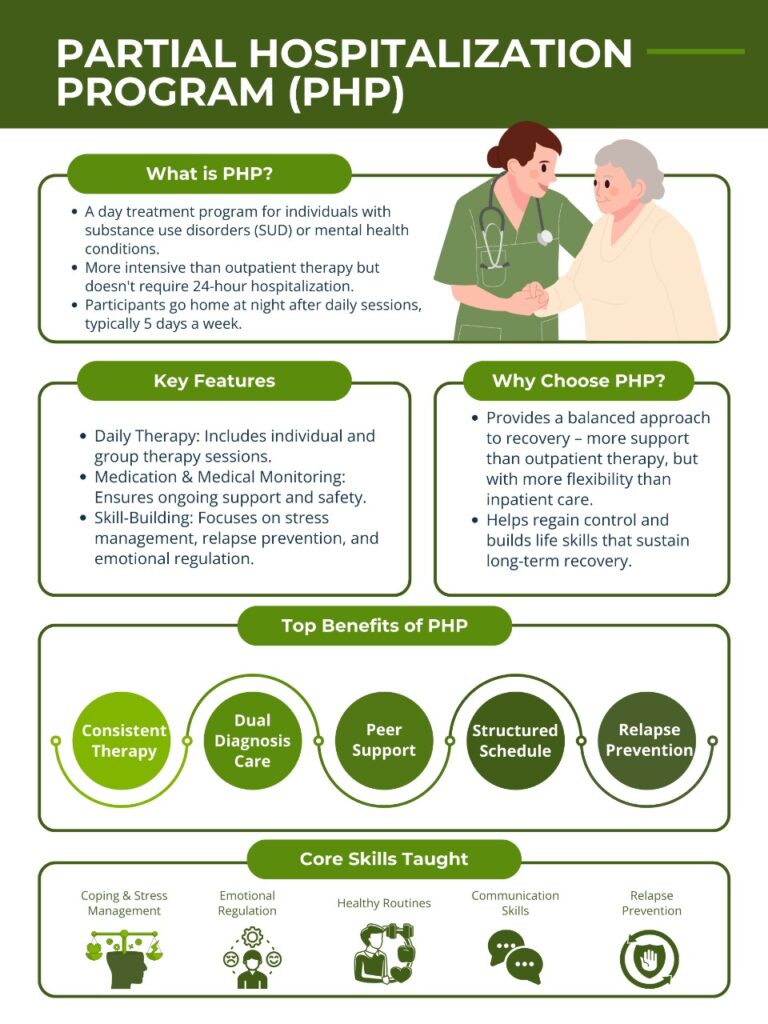
You start in Partial Hospitalization Programs (PHP). The first step down from inpatient care.
You’re attending treatment most of the day, five days a week, but sleeping in your own bed. Testing your sobriety in your real environment while still having intensive daily support.
Then you transition to Intensive Outpatient Programs (IOP). Three to five evenings per week. Several hours per session. You’re working again, or going to school, or taking care of your kids during the day. Then showing up for yourself in the evening. Learning how to balance recovery with responsibility.
Eventually, you step down to standard outpatient treatment. Once or twice a week. Still accountable. Still connected. Functioning more independently because you’ve practiced, with support, instead of being thrown in the deep end.
At Forrest Behavioral Health Center in Massachusetts, we create step-down programs, which come to acknowledge this fact: recovery is not linear, and support should not fade as soon as you walk out of residential treatment.
What Goes On Within Step-Down Programs
It is not like you are starting with a clean sheet of paper. Rather, you are extending what you have done in inpatient treatment. Putting your academic knowledge into practice with individuals who are able to help you when you fall down.
Individual therapy goes on but less often in comparison to inpatient. You are working out the day-to-day hardships of early sobriety. Surviving your first sober socializing event. Learning to sit and live with anxiety without drugs.
The value of group therapy is even higher in step-down care. You are around people who know how it feels to walk back into the life that almost ruined you and attempt to live it as a different person. They understand how it feels to pass by the bar. To see your old using buddies. To have your family treat you like you’re one bad day away from relapse.
Moreover, you get relapse prevention planning that’s specific and actionable. Not generic advice about self-care. Real strategies for real situations. How do you react when your toxic relationship partner shows up at your door, drunk? When you know all the people at the office happy hour are getting drunk, and you are drinking club soda and feel like an alien?
A variety of programs involve medication management of co-occurring mental disorders or medication-assisted treatment of opioid or alcohol use disorder. Why? Well, your brain chemistry doesn’t magically fix itself after 30 days. Therefore, pretending mental health doesn’t matter in addiction recovery is how people relapse.
How Long Before You’re Ready to Walk Alone?
There’s no universal timeline. Recovery is not a standardized prescription. Most clients participate in evening IOP for 6-12 weeks, but some need more. Some need less.
You stay in step-down treatment until your clinical team and you agree that you’re stable enough for less intensive support. Until you’ve practiced living sober in your actual life long enough that it’s becoming second nature instead of a daily battle.
Evening outpatient care ranges between 12 and 16 weeks for many programs. Long enough to establish new patterns. To get through multiple high-risk situations successfully. To build a support network that’s strong enough to hold you when things get hard.
The goal isn’t to keep you in treatment forever. It’s to give you enough supported practice at living sober that you can do it independently without feeling like you’re perpetually one trigger away from relapse.
Final Words
Step-down treatment in Massachusetts gives you what inpatient couldn’t: practice at real life with real consequences and real support. You learn how to be sober at your job, in your relationships, and in your empty apartment at 2 AM when the cravings hit. And you learn it with people who can help you course-correct instead of spiraling.
If you’re in Massachusetts and you’re about to complete inpatient treatment or you’ve already left and you’re struggling, there’s still time. Call Forrest Behavioral Health Center or visit our website. Our step-down programs are designed for people who know that recovery doesn’t end when you walk out of residential treatment.
Completing inpatient was the courageous part. Asking for continued support? That’s the smart part. The cliff is real, but you don’t have to jump. There’s a bridge. Use it.