

Forrest Behavioral Health

How to Know If You Need IOP Instead of Weekly Therapy in Illinois

How to Know If You Need IOP Instead of Weekly Therapy in Illinois

How to Know If You Need IOP Instead of Weekly Therapy in Illinois

If you feel stuck in weekly therapy, you are not alone. 

IOP in Illinois gives you several hours of care each week, while weekly therapy in Illinois usually gives you one session and then sends you back into daily life to manage the rest on your own. That difference matters when your symptoms keep spilling into work, school, sleep, or relationships.

A lot of people wait too long before moving up to a stronger level of care. In Illinois, 2,136,000 adults reported needing mental health treatment and not getting it by 2025, and Illinois 988 centers handled 145,762 calls in 2023

At Forrest Behavioral Health, we offer in-person and online care in Hoffman Estates, including PHP, IOP, and outpatient treatment for anxiety, depression, trauma, dual diagnosis, and substance use. This guide will help you spot the signs, compare your options, and decide if it is time to take a bigger step.

The Core Differences: Weekly Therapy vs. IOP in Illinois

Think of weekly therapy like a steady check-in. It can work well when life is hard but still manageable. IOP is different. It gives you more structure, more contact, and more time to practice skills while life is still happening.

That does not mean one is “better” for everyone. It means each one fits a different level of need. If you keep putting out emotional fires between sessions, IOP in Illinois may be the smarter fit.

Feature

Weekly Outpatient Therapy

Intensive Outpatient Program (IOP)

Hours Per Week

Usually 1–2 hours

Usually 9–15 hours

Core Modality

Mostly one-on-one therapy

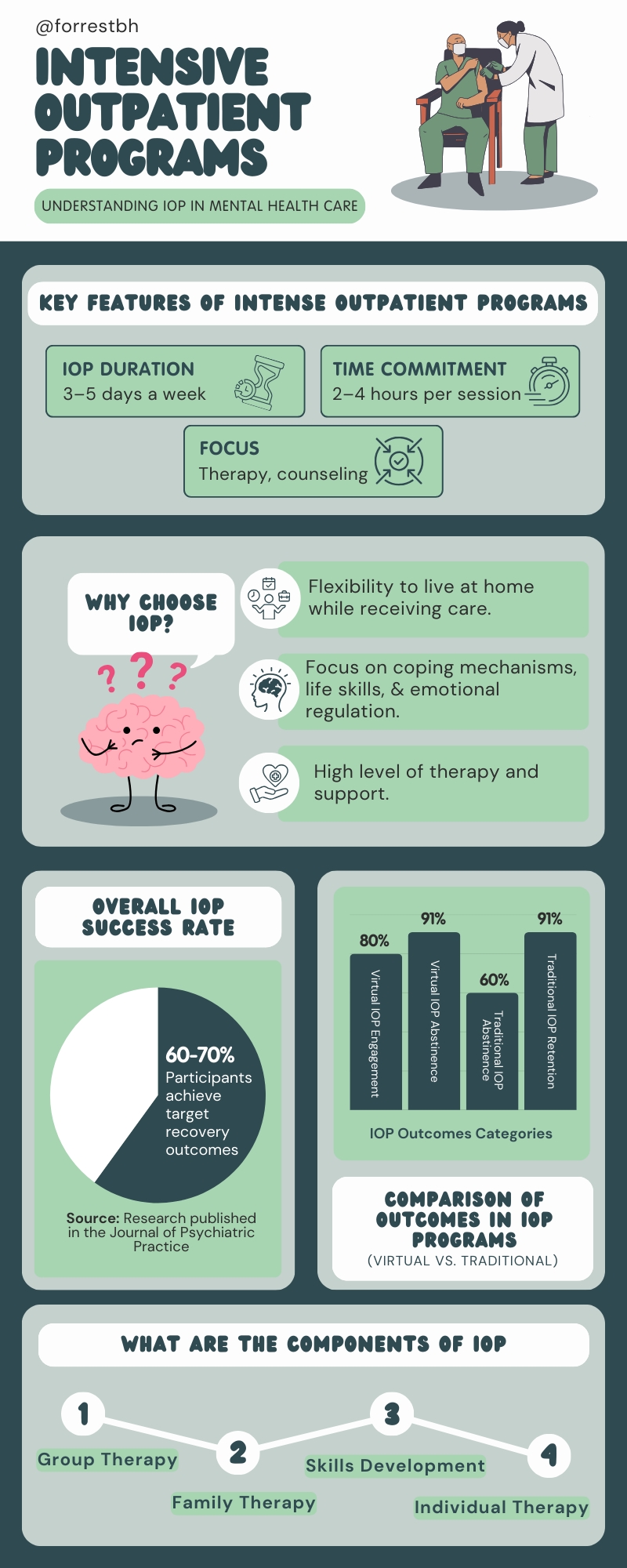
Group-focused care plus individual support

Medical Integration

Often outside referrals

May include on-staff psychiatric support

Pace of Care

Slower, spaced out

Faster, more structured

Crisis Risk Support

Limited between sessions

Closer monitoring and faster follow-up

Best Fit

Mild to moderate strain

Symptoms that keep disrupting daily life

5 Signs You Need an IOP Instead of Weekly Therapy

Sometimes the clue is not dramatic. It is the slow grind. You keep showing up, you keep talking, and yet your life still feels like it is sliding sideways.

Truth is, if your current care is not giving you enough traction, moving up a level is not failure. It is a wise course correction.

  • You Keep Repeating the Same Crisis: Each session turns into damage control. You spend the hour retelling the week instead of learning and using new skills.
  • Daily Life Is Slipping: Work feels impossible. Classes pile up. Laundry, meals, and showers start feeling like climbing a hill in wet shoes.
  • Your Coping Is Getting Riskier: Drinking more, isolating, self-harm thoughts, or staying in bed for long stretches can all point to a need for closer care.
  • You Know the Skills but Cannot Use Them: You understand breathing exercises, thought checks, and boundaries in theory. Then a real trigger hits, and everything goes out the window.
  • You Are Coming Out of a Crisis: After an ER visit, inpatient stay, or major relapse, weekly therapy may feel too thin. A stronger safety net can help you stay steady.
IOP intensive outpatient program forrest behavioral health forrestbh

Case Study: Moving From Weekly Therapy to IOP Care

38‑year‑old teacher in Chicago stuck with weekly therapy for months but kept missing school and crying in the parking lot. Her mood stayed low, and her household grew messy and tense. After a talk with her doctor, she moved into a 9‑hour‑per‑week IOP for depression. 

Over eight weeks, she joined group sessions, got medication support, and practiced daily coping skills. Studies published in Psychiatric Services show that IOP programs like this raise success rates to about 60–70% compared with lighter outpatient care. For her, mood scores improved, attendance at work steadied, and she felt ready to step down to weekly therapy with a solid plan.

➡️ Take the first small step toward healing by reading our latest blog, “What to Do If You’ve Been Putting Off Treatment in Illinois.” 

Navigating IOP Insurance and Clinical Criteria in Illinois

Insurance language can make your head spin. Still, the basic question is simple: do your symptoms interfere with life enough to justify a higher level of care?

Most providers look at the same core markers. They want to know how severe your symptoms are, how much your functioning has dropped, and whether you are safe to be at home between sessions.

  1. DSM-5 Diagnostic Severity: You have a documented mental health or substance use condition that needs more support than a weekly visit.
  2. Functional Impairment Scores: Your symptoms are hurting work, school, parenting, sleep, or relationships in a real, visible way.
  3. Safety and Cognitive Status: You are safe to sleep at home and able to take part in group work, reflection, and discussion.

At Forrest Behavioral Health, we offer a free 15-minute consultation and provide in-person and online care, which can make the first step feel less heavy.

FAQs

How Many Hours a Week Is an IOP in Illinois?

Most IOP schedules run about 3 hours a day, 3 to 5 days a week. That usually adds up to 9 to 15 hours. Some programs offer morning tracks. Others offer evening care for working adults. That extra time gives you more repetition, more support, and less time alone with a spiraling week.

Can I Work While Participating in an Intensive Outpatient Program?

Yes, many people do. That is one reason IOP in Illinois works well for adults who cannot step away from life completely. Unlike inpatient treatment, IOP lets you sleep at home and keep parts of your regular routine. It is a bit like adding scaffolding to a house while repairs happen. Life keeps moving, but now it has support.

Does Illinois Insurance Cover IOP Instead of Weekly Therapy?

  • Pre-Authorization: Many plans want a clinical assessment first.
  • Medical Need: Coverage often depends on symptom severity and daily impairment.
  • In-Network Costs: Your deductible, copay, and network status can change what you pay.
  • Program Type: Some plans cover mental health IOP and substance use IOP under different rules.

Finding the Right Level of Care for You

Moving from weekly therapy to IOP is not a step backward. It is often the move that helps things finally click. When your symptoms keep outpacing one session a week, more structure can give you the steady ground you have been missing.

At Forrest Behavioral Health, we offer PHPIOP, and outpatient care in Hoffman Estates, along with CBTDBT, and treatment for anxiety, depression, trauma, dual diagnosis, alcohol use, and substance use. If you are unsure which level fits, start with a confidential assessment. One honest conversation can save you months of spinning your wheels.

Forrest Behavioral Health

Are you ready to overcome your addiction or learn more about our treatment programs? We are here for you.

Related Articles

Lowell Mental Health Treatment How Lowell Mental Health Treatment Can Improve Your Relationships and Daily Life
Mental Health Treatment
Forrest BH

Lowell Mental Health Treatment

Could improving your mental health transform your relationships, confidence, and daily routine? Discover the surprising ways treatment in Lowell can change more than just your symptoms.

Read More »
leaf

Need treatment?

Get a call to start your recovery journey.

"*" indicates required fields

Other Posts

Verify Approval for www.forrestbh.com

Are you ready to overcome addiction? We encourage you to request a phone call from a recovery specialist.

"*" indicates required fields