

Forrest Behavioral Health

What a Full Week in an IOP Program Looks Like in Illinois

What a Full Week in an IOP Program Looks Like in Illinois Inside An Intensive Outpatient Program: What A Full Week Looks Like In Illinois

Inside An Intensive Outpatient Program: What A Full Week Looks Like In Illinois

If you are trying to stay sober while still going to work, paying bills, and showing up for family, traditional outpatient care can feel like a drop in the bucket. You leave a 45‑minute session feeling understood, only to crash back into the same triggers a few hours later. On the other hand, inpatient rehab can feel like ripping your life apart just to heal.

That is where an Intensive Outpatient Program steps in. For Illinois residents, an IOP program Illinois offers a middle ground. You keep sleeping in your own bed, managing your job, and staying close to your people while still getting structured, high‑intensity support. 

In this guide, you will see exactly what a full week in an IOP program looks like, how it fits into daily life, and why many people finally find traction here.

What Is An IOP Program Illinois Residents Can Access?

An Intensive Outpatient Program (IOP) in Illinois is not just “more therapy.” It is a step on the formal care ladder. Think of it as Level 2.1 on the ASAM continuum, which sits between standard outpatient care (Level 1) and residential treatment (Level 3).

That means you are stable enough to live at home, but you still need organized support several times a week. Many people join an IOP program Illinois offers when they step down from detox or residential care, or when weekly therapy clearly is not enough to hold their symptoms back.

  • 9 to 19 hours of clinical treatment each week.
  • Flexible morning or evening session tracks around work or school.
  • A step‑down structure as you hit recovery milestones.
  • Peer‑based group therapy alongside individual counseling and family support.

This structure makes an IOP program Illinois habitable for adults who cannot take weeks off from life.

Core Components Of The IOP Program Schedule

If you picture an IOP program, you can think of it as a mix of classes, support groups, and private check‑ins. Each element has a clear job to do.

Many Illinois behavioral health centers design their IOP program so that you repeat certain skills until they sink in. You may attend the same type of group several times a week, but each session builds on the last. That repetition is what helps coping skills move from theoretical ideas to real‑life habits.

Typical IOP Weekly Structure

Therapy Type

Frequency Per Week

Core Focus & Objective

Group Therapy

3–5 sessions

Teach peer support, everyday coping tools, and shared accountability.

Individual Counseling

1–2 sessions

Dive into your triggers, history, and personalized goal setting.

Family Therapy

1 session (weekly or biweekly)

Repair family dynamics, improve communication, and build a support system at home.

Psychoeducation

Integrated daily

Help you understand addiction biology, trigger identification, and relapse prevention.

This mix keeps you supported emotionally, socially, and physically while you stay in your real life.

A Day-By-Day Breakdown: A Full Week In An IOP Program

An IOP program Illinois rarely feels random. There is usually a quiet rhythm to the week. You can think of it as training for your mind and emotions while life keeps spinning around you.

Below is what a typical full week in an IOP program may look like. Exact times and details vary by facility, but the pattern is familiar across many centers.

Monday & Tuesday: Building The Foundation

These early days tend to be about resetting after the weekend and warming up your “recovery muscles.”

Check‑In and Accountability

  • Urine drug screen at the start of each day if you are in a substance‑use IOP.
  • Group check‑ins where everyone shares their weekend highs and lows.

Skill Building

  • Focus on Cognitive Behavioral Therapy (CBT) basics to handle early‑week cravings.
  • Practice identifying automatic thoughts and replacing them with healthier self‑talk.

Peer Dynamics

  • Light group discussions that focus on current stressors like money, relationships, or work.
  • Building trust and noticing who tends to support you versus who drains you.

By Tuesday, you may already feel a bit more grounded than you did on Sunday night.

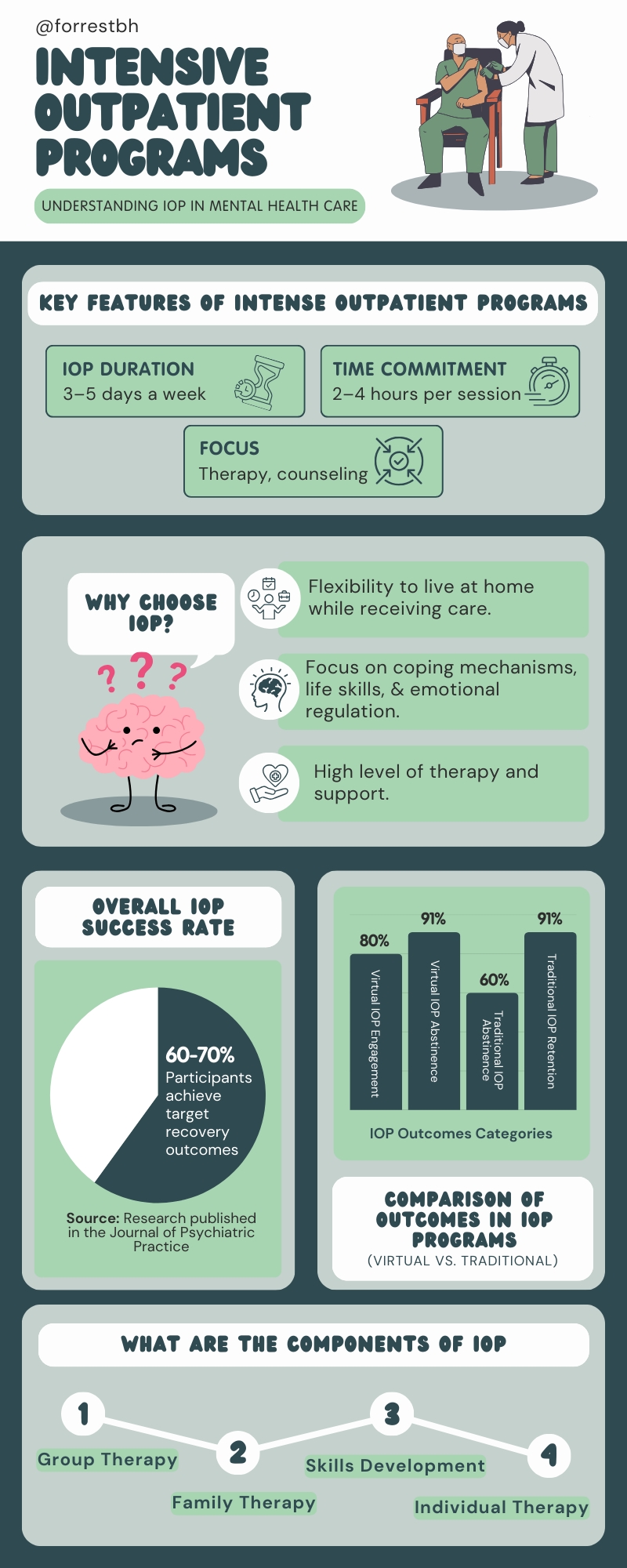
IOP intensive outpatient program forrest behavioral health forrestbh

Wednesday & Thursday: Deepening The Recovery Work

Midweek is usually when the real emotional work starts to sink in. You are no longer just “going through the motions.” You are starting to feel the weight of your patterns and the relief of new tools.

Mid‑Week Assessment

  • Therapists may check in with you privately about cravings, mood, and motivation.
  • Adjust your coping mechanisms if you have been struggling with the same triggers.

Family Inclusion

  • Evening family therapy sessions once or twice a week if your IOP program Illinois includes them.
  • Learn how to talk about your recovery without blame or shame.

Dialectical Behavior Therapy (DBT)

  • Focus on distress tolerance and emotional regulation if your program uses DBT.
  • Learn how to pause when you feel like reacting, instead of jumping straight into old habits.

These days can feel tiring, but honest. You are still living your life, but now you have a team helping you rethink how you live it.

Friday: Relapse Prevention And Weekend Planning

Friday often feels bittersweet. You have built some momentum, but you also know the weekend is about to hit. That is why relapse prevention and planning come to the forefront.

Weekend Safeguards

  • Create a written safety plan for your highest‑risk hours, such as Friday and Saturday nights.
  • Identify who you can call, places you can go, and activities that keep you occupied.

Alumni Connections

  • Many IOP programs Illinois connect you with local support groups like AANA, or Smart Recovery.
  • You may attend one or two meetings with a counselor or alumni as a trial run.

Graduation Milestones

  • Celebrate peers who are stepping down to outpatient care or finishing the program.
  • Witnessing their progress can remind you that recovery is possible and visible.

By Friday afternoon, you are not just “getting through” another week. You are planning how to carry what you learned back into the real world.

➡️ Ready to see if you need more support than weekly therapy? Read our latest blog, How to Know If You Need IOP Instead of Weekly Therapy in Illinois,” to decide which level of care fits your life right now. 

Case Study: Overcoming Alcohol Use Disorder In Chicago

32‑year‑old teacher in Chicago tried weekly therapy for Alcohol Use Disorder but still missed school and felt shaky every morning. After a talk with her doctor, she entered a 12‑week IOP, meeting three evenings a week for three hours each. 

That created about 9 hours of therapy per week, with group work, CBT, and DBT. Over time, her cravings dropped, her sleep improved, and she stayed at her job. 

Data from SAMHSA and Illinois recovery centers show that this kind of structured IOP often boosts retention above 80% and lowers relapse. 

FAQs

How Many Hours A Week Is IOP in Illinois?

Under Illinois state guidelines, a standard IOP typically offers 9 to 19 hours of clinical treatment per week. Most centers divide that into 3‑hour sessions, about 3 to 5 days a week. You can often choose morning tracks if you want to get treatment done before work, or evening tracks if you are busy during the day.

Can I Work Full-Time While Participating in an IOP Program?

Yes. That is one of the biggest reasons people choose an IOP program Illinois over inpatient care. You keep your job, your kids, your responsibilities, and your own bed. You simply add a few structured therapy blocks into your week. Many people find that this balance helps them actually use the skills they learn in real time.

Does Health Insurance Cover an IOP Program Illinois Residents Utilize?

Most major private plans, BCBSAetnaCigna, and Medicaid options in Illinois cover IOP when it is medically necessary. Your IOP program Illinois facility will usually handle pre‑authorization and send documentation to your insurance. You may still have copays or deductibles, but those costs are often much lower than residential treatment.

Taking The First Step Toward A Full Week in an IOP Program

full week in an IOP program is not a life sentence. It is a short, focused experiment in living differently. You keep your job, your home, your people, and your routines, while quietly upgrading how you handle stress, triggers, and cravings.

If you have been hanging on with weekly therapy but still feel like you are barely surviving, an IOP program Illinois residents rely on may be the upgrade you need. At Forrest Behavioral Health, our team can walk with you through a confidential assessment and help you choose a schedule that fits your life, your limits, and your hopes.

You do not have to start by “fixing everything.” You only have to start by adding one solid hour of intentional support.

Forrest Behavioral Health

Are you ready to overcome your addiction or learn more about our treatment programs? We are here for you.

Related Articles

Lowell Mental Health Treatment How Lowell Mental Health Treatment Can Improve Your Relationships and Daily Life
Mental Health Treatment
Forrest BH

Lowell Mental Health Treatment

Could improving your mental health transform your relationships, confidence, and daily routine? Discover the surprising ways treatment in Lowell can change more than just your symptoms.

Read More »
leaf

Need treatment?

Get a call to start your recovery journey.

"*" indicates required fields

Other Posts

Verify Approval for www.forrestbh.com

Are you ready to overcome addiction? We encourage you to request a phone call from a recovery specialist.

"*" indicates required fields