

When Life Can’t Stop And You Can’t Keep Going Either: IOP for Dual Diagnosis in MA
You have a job. Bills that won’t pay themselves. People depending on you. A life that can’t just pause while you disappear for treatment.
Still, you also have this other thing happening. Depression that makes mornings feel like drowning. Anxiety screaming in your head at 3 AM. And somewhere along the way, substances became the solution. The thing that made it all bearable.
Except now they’re not working anymore. Are they?
So what happens when you require assistance but cannot disappear into a facility to spend 30 days? Checking out is not possible, and neither is staying like this? That’s the impossible choice. And that’s where Intensive Outpatient Programs exist. In that space between “I can handle this” and “I need to disappear to fix this.”
The Thing Nobody Says Out Loud
Everything is connected to everything else, and you can’t tell where one problem ends and the next begins.
You feel nervous, and you drink to make the volume low. Your sleep is destroyed by the alcohol. Your depression becomes even worse due to the sleep deprivation. The depression causes you to lose interest in consequences. As a result, the substance use increases. And the substances mess with your brain chemistry, making the anxiety and depression even worse.
See the pattern? It is a snake, which feeds upon itself. And you’re stuck in the middle watching it happen.
It’s not because you’re weak. It is not a trait of weakness. Your mind is simply surviving with what it is able to use. The problem? Those tools are actively destroying you.
And traditional treatment? It wants to separate everything. Go here for addiction. Go there for depression. Take these pills for anxiety. However, when everything is tangled together like Christmas lights you shoved in a box last year, pulling on one strand just makes the whole mess tighter.
You can’t fix half the problem and expect the other half to magically improve.
What An IOP Is And What A Week There Looks Like
Let’s be clear: Intensive Outpatient Programs aren’t “rehab lite.” They’re not the easier option for people who don’t really need serious help.
IOP is real treatment. Structured. Clinical. Intense. It fits around a life that’s still running.
You show up three to five days a week. Three to four hours at a time. You do group therapy, individual sessions, medication management, and skills work. Actual clinical treatment with professionals who specialize in this exact combination of struggles.
And then you leave. You go to work. You pick up your kids from school. You navigate your life with your specific triggers and stressors.
Most programs schedule around jobs with early morning or evening sessions. Three to five times per week. You’re looking at 9 to 15 hours of treatment weekly. This isn’t showing up once a week to catch your therapist up on what happened. This is showing up every single day to do the work.
What work? Group therapy where everyone in the room is fighting both battles: mental health and substances. Individual therapy gets into your patterns, your trauma, and the things that are beneath the things. Taking medicine under the supervision of a psychiatrist who would know how alcohol will interfere with antidepressants or how benzos will make anxiety treatment more difficult. Skills training for when the cravings hit or when your brain starts lying to you about using “just this once.”
The frequency isn’t random. When you’re rewiring your entire approach to both mental health and substances, you need daily support. Not weekly check-ins. Daily.
Why Treating Both Together Works
The research isn’t ambiguous here: treating co-occurring disorders together beats treating them separately. Every single time.
You can’t address addiction without looking at the anxiety driving it. And you can’t treat depression while ignoring the substances undermining every medication and coping skill you’re trying to build.
In dual diagnosis IOP, everything gets addressed at once. It’s not really two separate problems. It’s one massive interconnected struggle that needs one comprehensive approach.
What does that look like when you’re sitting in the room?
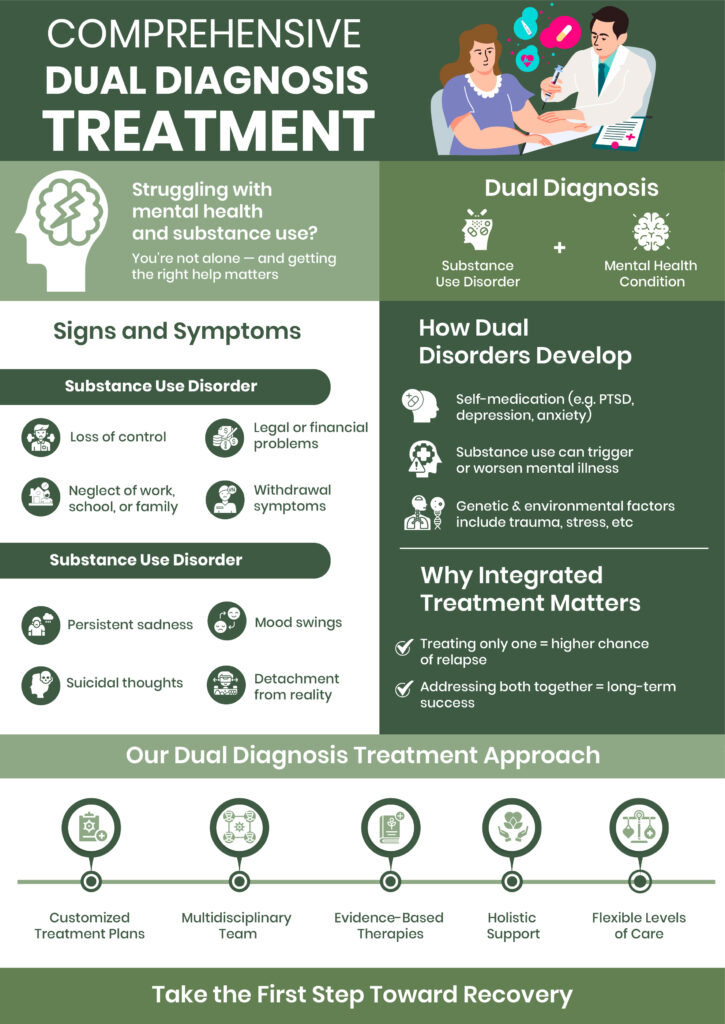
Your therapist doesn’t dance around your drinking when you’re talking about your depression. Your addiction counselor doesn’t skip over the panic attacks that trigger cravings. Your psychiatrist is adjusting medications with full knowledge that opioids or alcohol are in the picture, planning for what happens as you taper down or stop.
Is IOP Right for Me?
IOP works when you need more than weekly therapy but less than someone watching you 24/7.
It’s right if you’ve completed detox and you’re medically stable. If you can keep yourself safe between sessions. If you have some kind of support system or stable place to live. If you need serious treatment but your responsibilities can’t completely stop.
IOP isn’t right if you’re in immediate crisis. If you need medical detox. If you require round-the-clock monitoring. In those cases, you need a higher level of care first. And that’s completely okay. You step down to IOP when you’re ready.
There’s no shame in needing what you need. The goal is matching your situation to the level of care that will work. Not willpower. Not toughness. Just an honest assessment.
What We Do at Forrest Behavioral Health
We built our IOP specifically for dual diagnosis. Our clinicians don’t just “know about” addiction or mental health; they live at the intersection. That’s their specialty.
We use evidence-based therapies that work for co-occurring disorders. CBT to rewire the thought patterns. DBT to control emotions when it all seems too much. Motivational interviewing to assist you to discover your own reasons to change. Not ours, yours.
Groups are small. You’re not a face in a crowd of 30 people. You connect with others fighting the exact same dual battle. And that shared understanding? It becomes its own kind of medicine. Scheduling is flexible because we know you have a life. We work with that. Not against it.
Final Words
You don’t need to have everything figured out. You don’t need to know if you’re “ready” or whether this will definitely work or any of that.
You just need to pick up the phone.
Forrest Behavioral Health accepts most major insurance. Money shouldn’t be the thing that keeps you stuck.
Call us. Talk to somebody who knows what you are dealing with. Ask your questions. Get answers in the real world on what IOP entails and whether it is applicable to your scenario or not, and what the first step is going to look like.
How long have you been attempting to cope with this on your own? Let’s see what happens when you don’t have to anymore.