

Forrest Behavioral Health

Intensive Outpatient Program (IOP) For Addiction In Massachusetts

Intensive Outpatient Program (IOP) For Addiction In Massachusetts What to Expect from Intensive Outpatient Program (IOP) and How it Supports Recovery

What to Expect from Intensive Outpatient Program (IOP) and How it Supports Recovery

“Sometimes You Need More Help Than Weekly Therapy, But You Still Need To Sleep In Your Own Bed.” 

That is where an Intensive Outpatient Program (IOP) For Addiction In Massachusetts can help. Research shows that substance abuse IOPs can reduce drug and alcohol use as effectively as inpatient and residential programs for many people, especially when they provide 9–19 hours of structured care per week. 

An IOP is a structured treatment for substance use and mental health that you attend several days a week while still living at home. It is in between inpatient rehab and standard outpatient care, so it offers both flexibility and strong support. 

In this guide, we at Forrest Behavioral Health explain how IOP works, what to expect from our program, who it is for, and how to get started with a plan that fits your life.

What Does Intensive Outpatient Program (IOP) Mean?

An Intensive Outpatient Program (IOP) for Addiction in Massachusetts is a non‑residential treatment program that offers more structure than weekly therapy but does not require you to stay overnight. You live at home or in a sober living environment and attend therapy and skills groups several days a week.

This balance lets you stay involved in work, school, and family while still getting focused support for addiction and mental health. At Forrest Behavioral Health, our IOP is designed to combine intensive care with independence and personal responsibility, so you can practice recovery tools in real life between sessions.

How IOP Fits Into The Continuum Of Care

IOP is part of a broader “ladder” of care. At higher levels, some people start with medical detox or residential or day treatment when withdrawal or safety concerns are stronger. At lower levels, standard outpatient care usually means one or two visits per week.

Our Intensive Outpatient Program (IOP) For Addiction In Massachusetts can be a step‑down after more intensive care or a step‑up if weekly outpatient therapy is not enough. This flexibility helps us match support to what you are facing right now and then adjust as you grow.

How Is An Intensive Outpatient Program (IOP) Structured?

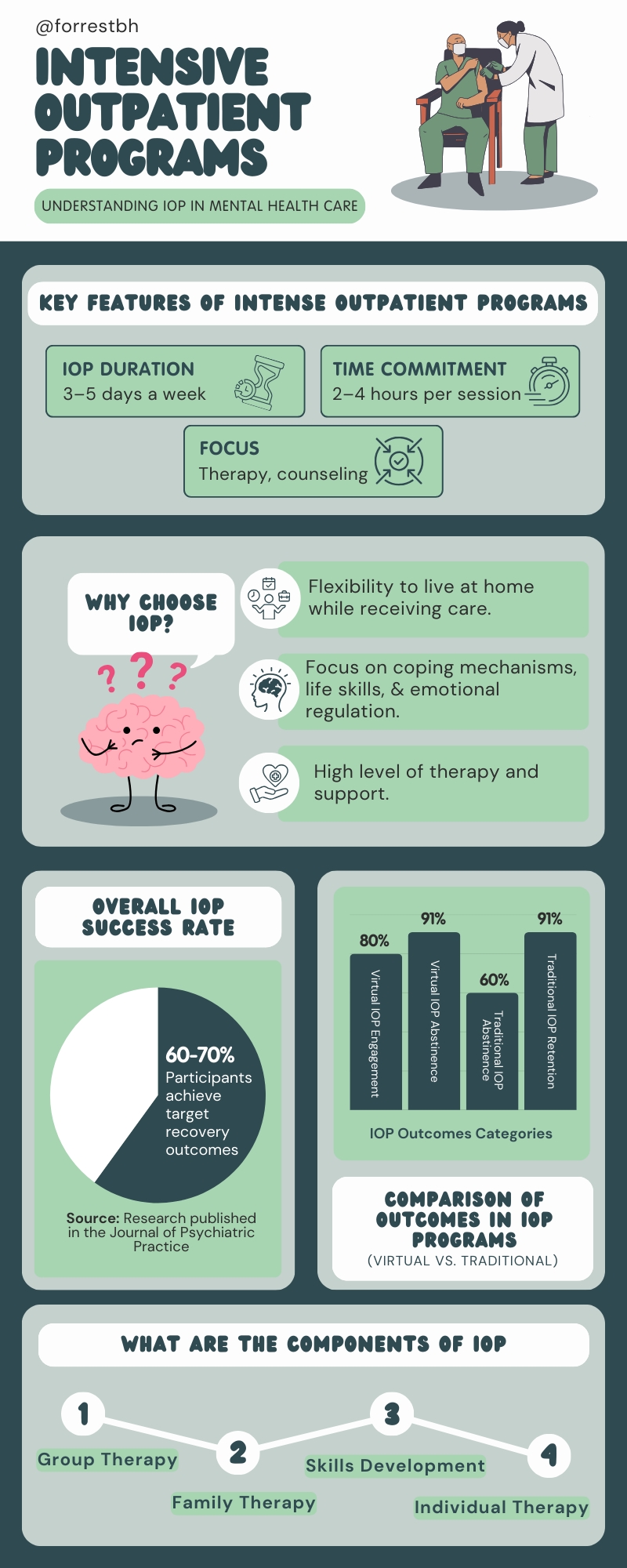
An average IOP program for addiction in Massachusetts involves between three and five days a week of hours-long sessions. This totals a concentrated block of treatment every week, with time left over for work or school obligations.

At Forrest Behavioral Health, our IOP is available during the day or evening, depending on program track and availability—you pick what suits you. It’s best to attend regularly, so your skills develop consistently. Also, a big part of the treatment is for everyone to show up consistently because everyone being regular is a key part for the group to feel trustworthy and supportive during the treatment process.

Core Components Of IOP Treatment

Our Intensive Outpatient Program (IOP) for Addiction in Massachusetts offers a unique mix of interconnected services:

  • Clinical evaluation and specific treatment.
  • Individual therapy (one‑to‑one counseling).
  • Group therapy a few times a week.
  • Skills groups aimed at coping skills, relapse prevention, and life skills.
  • Family involvement when appropriate.
  • Testing for drugs and alcohol, as well as regular progress checks.
  • Communication with appropriate medical or psychiatric professionals as necessary.

What Can You Expect In Our Intensive Outpatient Program (IOP) In Massachusetts?

Our IOP For Addiction In Massachusetts is developed to fit your recovery with the demands of life. We structure IOP with specific start and end times so that you can plan around work and family, and we can talk about helping you think through how to protect your time for treament.

This bend-but-not-break schedule allows you to stay plugged into life and to do new things at the same time. For many, they find this structure enough of a support to change when the time is right, without feeling like they need to leave everything that matters.

Evidence‑Based Therapies Used In IOP

In our IOP, we rely on proven approaches rather than guesswork. These may include:

  • CBT (Cognitive Behavioral Therapy) to help you notice and change unhelpful thoughts and behaviors.
  • DBT (Dialectical Behavior Therapy) skills to support emotion regulation and distress tolerance.
  • Motivational interviewing to strengthen your own reasons for change.
  • Trauma‑informed approaches that respect past experiences and focus on safety.
  • Relapse‑prevention and coping‑skills training, so you know what to do when cravings or stress appear.

Clinical Team in An IOP For Addiction In Massachusetts

Our Intensive Outpatient Program (IOP) for Addiction in Massachusetts is led by a team trained in addiction and mental health. This team may include licensed therapists, addiction specialists, and medical or psychiatric providers, depending on your needs.

Each role adds something important. Therapists focus on patterns and skills; medical providers manage physical and psychiatric needs; and case managers help with practical issues that can affect recovery, such as housing or work. Together, they aim to understand you as a whole person, not just a diagnosis.

Why A Multidisciplinary Team Matters

When different professionals communicate and work together, care is more complete and consistent. At Forrest Behavioral Health, our team reviews cases regularly, discusses progress and challenges, and adjusts treatment plans when needed.

This multidisciplinary approach helps catch issues early, such as rising anxiety, increased stress, or new triggers, and respond before they lead to relapse. It also supports smoother coordination if you need to step up or step down between levels of care.

How Intensive Outpatient Programs Support Addiction Recovery

Our Intensive Outpatient Program (IOP) for Addiction in Massachusetts is not only about stopping substance use. It is also about understanding why the use started, why it continued, and what needs to change in your daily life for recovery to last.

IOP gives you time and space to look at underlying causes such as trauma, chronic stress, or mental health symptoms. You also work directly on triggers, cravings, high‑risk situations, relationship patterns, and boundaries, so you can apply what you learn as soon as you walk out the door.

Peer Support And Community In IOP

Group therapy is a core part of our IOP because healing does not happen alone. In group, you meet others who are working through similar struggles, which can reduce shame and isolation.

Peers can offer accountability, encouragement, and practical strategies that they have tested in real life. Over time, many people find that their IOP group becomes a strong source of motivation and support.

Dual Diagnosis And Mental Health in An Intensive Outpatient Program (IOP) In Massachusetts

A dual diagnosis means you are facing both a substance use disorder and one or more mental health conditions, such as depression or anxiety. Our Intensive Outpatient Program (IOP) for Addiction in Massachusetts is designed to treat these conditions together instead of separating them.

Ignoring one side usually makes the other harder to manage. For example, untreated depression can increase cravings, and unaddressed trauma can make it difficult to stay in recovery. Integrated dual‑diagnosis care aims to improve both mental health and substance use outcomes at the same time.

Common Co‑Occurring Conditions Treated

In IOP, we often work with people who are managing:

  • Depression
  • Anxiety
  • PTSD and other trauma‑related symptoms
  • Bipolar disorder
  • Other emotional and behavioral concerns

When both addiction and mental health are addressed in one plan, people often feel more stable and less at risk of relapse, because they have tools to manage more than one source of stress.

Medical And Medication Support In IOP For Addiction In Massachusetts

Medication can be part of care in an Intensive Outpatient Program (IOP) For Addiction In Massachusetts when it is clinically appropriate. For some people, this may include medications that reduce cravings or support withdrawal safety, or psychiatric medications that help manage mood, anxiety, or other symptoms.

At Forrest Behavioral Health, we see medication as one tool among many. It works best when combined with therapy, monitoring, and strong coping skills, rather than used alone. We also recognize that not everyone will need or want medication, and those decisions are made case by case.

How Medical Care is Coordinated

When medication is part of your plan, prescribers, therapists, and case managers communicate about how you are doing and what you are noticing. Follow‑up visits help track benefits, side effects, and any needed changes.

This coordination is part of what makes an Intensive Outpatient Program (IOP) for Addiction in Massachusetts more comprehensive than seeing different providers who rarely speak to one another. It also helps ensure that your medical care lines up with your therapy goals.

Family Involvement In An Intensive Outpatient Program (IOP)

The addiction does not affect just one person, so family involvement is also very important in our Intensive Outpatient Program (IOP) for Addiction in Massachusetts. In circumstances where it is safe and relevant, involving family or a close support person may be helpful in enhancing understanding and communication.

Families can be taught what addiction and mental health challenges look like, what is helpful, and what is not. That may help reduce blame, increase support, and establish healthier boundaries at home.

Family Services Offered

Depending on your circumstances, family‑related choices may include:

  • Classes for family education to teach addiction and recovery.
  • Family therapy sessions to improve communication and trust.
  • Family check‑ins, where loved ones can ask questions and learn how to support without enabling.

At Forrest Behavioral Health, we help families understand that recovery is a shared process and that support can be strong while still respecting everyone’s needs and limits.

Who is a Good Candidate For Intensive Outpatient Program (IOP) for Addiction in Massachusetts?

IOP is not the right fit for everyone, but it can be effective for many people when the timing and conditions are right. A good candidate for an Intensive Outpatient Program (IOP) for Addiction in Massachusetts usually has some stability in life but needs more support than weekly therapy.

Our goal is to help you find the level of care that matches your needs now, not to push you into a program that does not fit. We use assessments and clinical judgment to make these recommendations together with you.

When IOP is Often A Good Fit

IOP may be appropriate when:

  • Withdrawal risk is mild to moderate and already stabilized or managed elsewhere.
  • Substance use is moderate or severe but does not require 24/7 care.
  • You have stable housing and a reasonably safe home environment.
  • You are motivated to attend regularly and participate actively.
  • You need to balance treatment with work, school, or caregiving.
IOP intensive outpatient program forrest behavioral health forrestbh

When A Higher Level Of Care May Be Needed First

Sometimes, a higher level of care is safer before starting an Intensive Outpatient Program (IOP) for Addiction in Massachusetts. That may be the case if there are:

  • Unmanaged or severe withdrawal symptoms.
  • Acute psychiatric risk, such as suicidality or psychosis.
  • An unsafe or highly unstable living environment.
  • Multiple recent relapses despite strong outpatient support.

In these situations, we may recommend a higher level of care first, then use IOP as a step‑down once you are more stable.

How Long Does An Intensive Outpatient Program (IOP) For Addiction In Massachusetts Last?

Length of stay in an Intensive Outpatient Program (IOP) For Addiction In Massachusetts is not the same for everyone. Many programs offer a range, for example, the main phase is eight to twelve weeks, but they also offer an additional extension in case you feel like you need more support.

Intensity can be lowered as you improve your skills and demonstrate sustained stability. You may, for instance, begin with more days per week and then taper down to fewer or move to standard outpatient treatment as needed. 

Factors That Influence Length Of Stay

Your time in IOP depends on several factors, including:

  • Severity of substance use and mental health symptoms.
  • Progress in therapy and relapse‑prevention skills.
  • Strength of your support system and real‑life demands.
  • Insurance coverage and clinical recommendations.

We review these factors together with you and adjust the plan so that care is long enough to be helpful but not longer than needed.

Can You Work Or Go To School While In An IOP In Massachusetts?

One of the main reasons people choose an Intensive Outpatient Program (IOP) for Addiction in Massachusetts is because they want to keep working or going to school. IOP is designed to make this possible when schedules and responsibilities allow.

At Forrest Behavioral Health, we aim to build schedules that give you the best chance to attend treatment and still meet your key responsibilities. This often means offering sessions outside typical work or class hours or helping you plan around your existing commitments.

Balancing IOP with Daily Responsibilities

Balancing IOP with daily life takes planning, but it is possible. It may help to:

  • Talk with your employer or school about your schedule if you feel comfortable.
  • Plan transportation and travel time before your first week.
  • Use time‑management tools, such as calendars and reminders.

In some cases, reducing hours or adjusting commitments for a short time can protect your recovery early on. Honest planning with your treatment team can make IOP more realistic and sustainable.

Measuring Progress and Preventing Relapse in Intensive Outpatient Program (IOP) for Addiction

In our Intensive Outpatient Program (IOP) for Addiction in Massachusetts, we do not rely on guesswork to see if treatment is helping. We track progress through regular check‑ins, goals, and, when appropriate, screening tools and monitoring.

If things are going well, that helps confirm the plan is on track. If you are struggling or at risk of relapse, we can adjust intensity, focus, or support rather than waiting for a crisis.

Relapse Prevention and Coping Skills

Preventing relapse is a major focus of IOP. You will work on:

  • Identifying triggers, warning signs, and “slips.”
  • Building coping strategies for stress, cravings, emotions, and social pressure.
  • Learning how to respond quickly when you notice early warning signs.

We also encourage the use of support groups and sober activities outside the Intensive Outpatient Program (IOP) for Addiction in Massachusetts so that your support network continues to grow beyond treatment hours.

Aftercare and Next Steps After an Intensive Outpatient Program (IOP) in Massachusetts

Finishing IOP is not an endpoint; it is a transition. That is why we view aftercare as part of the Intensive Outpatient Program (IOP) for Addiction in Massachusetts, not something separate. A strong next‑step plan helps you keep your recovery momentum once the schedule becomes lighter.

Your plan will reflect your progress, your support system, and your goals. It may include step‑down options, therapy, peer support, and practical strategies to use in high‑risk situations.

Step‑Down and Ongoing Support

After IOP, you may:

  • Move into standard outpatient therapy.
  • Join support groups or peer recovery programs.
  • Participate in alumni or check‑in groups if available.

Building a Long‑Term Recovery Plan

We work with you to create a long‑term relapse‑prevention plan that includes:

  • People you can contact for support.
  • Places and activities that support sobriety.
  • Coping tools for stress, cravings, and difficult emotions.
  • Emergency steps if you feel at risk of relapse.

We also encourage continued mental health care for co‑occurring conditions so that improvements in mood and functioning help support your recovery from addiction.

Cost and Insurance for Intensive Outpatient Program (IOP) for Addiction in Massachusetts

Cost for an Intensive Outpatient Program (IOP) for Addiction in Massachusetts depends on factors like how many sessions you attend each week, how long you stay in the program, and what your insurance covers.

To reduce surprises, it is wise to verify benefits early and ask for an outline of expected copays, deductibles, and any prior authorization requirements. Taking this step early often reduces financial stress and lets you focus on treatment.

Questions to Ask About Payment

When you call, you might ask:

  • Do you accept my insurance, and what are my deductibles and copays?
  • Are payment plans or self‑pay options available if needed?
  • Will someone help me verify coverage and explain costs before I start?

At Forrest Behavioral Health, our team can walk you through these details so you can make informed decisions.

Case Study

Take Jess from Sameem Behavioral Health in Massachusetts. She wrapped up detox and jumped into their IOP, hitting 4 days a week at first. 

Two weeks in, she cut back to 3 days and got back to her job—full shifts twice weekly, half-days on treatment days. 

Medication helped her manage cravings, letting her juggle work and healing. This kind of step-down setup proves IOP lets folks hold onto jobs while rebuilding.

How to Start an Intensive Outpatient Program (IOP) for Addiction in Massachusetts

Step 1: Starting an Intensive Outpatient Program (IOP) 

Starting treatment may feel like a big step, but you do not have to do it alone. At Forrest Behavioral Health, we aim to make the first call feel calm, respectful, and informative.

You can contact us by phone or through our website to ask about fit, levels of care, and next available openings. All inquiries are confidential, and our admissions team is used to answering questions from people who are nervous or unsure.

Step 2: Complete an Assessment and Verify Insurance

Next, we set up an assessment to go over your history and current symptoms as well as goals. This informs us whether IOP is the appropriate level of care, or if anything else would be safer or more helpful.

Meanwhile, we assist you in verifying insurance and talking about scheduling options so that you have an understanding of how treatment can fit into your life before things ever begin.

Step 3: Begin IOP and Build a Step‑Down Plan

As soon as you start our Intensive Outpatient Program (IOP) for Addiction in Massachusetts, you will have met your treatment team, be introduced to your therapy groups, and are ready to set early goals. We will discuss with you options, step-down facilities, and aftercare as you go through the program so that you have a plan for stepping down.

➡️ Read our latest blog, “Outpatient Addiction Treatment in Massachusetts,” for a clear overview of care options and next steps—and if you need immediate support, SAMHSA’s free, confidential National Helpline is available 24/7.

Why Choose Forrest Behavioral Health’s Intensive Outpatient Program (IOP) In Massachusetts?

Many centers provide IOP, but not all programs are alike. Our IOP for Addiction in Massachusetts allows balancing personalized, evidence‑based care with robust dual‑diagnosis support and an easy-to-maintain schedule that fits your life.

We also focus on long‑term rehabilitation, not short fixes. That means we pay attention to mental, physical, social , and emotional health; and plan for the next steps with you from the start, not just at discharge.

Our Approach to Whole‑Person Recovery

Our approach includes:

  • Addressing both addiction and mental health when appropriate.
  • Aiding you in restoring daily routines and relationships.
  • Providing you with the tools and support that extend beyond IOP.

We think of recovery as being more than the ending of substance use. It’s about rebuilding a life that seems worth preserving.

Contact Forrest Behavioral Health today to request a confidential assessment and explore whether our Intensive Outpatient Program (IOP) is the right next step for you.

Call (781) 570-5781 or visit our Contact page to verify insurance and get started with a plan that fits your schedule.

Forrest Behavioral Health

Are you ready to overcome your addiction or learn more about our treatment programs? We are here for you.

Related Articles

leaf

Need treatment?

Get a call to start your recovery journey.

"*" indicates required fields

Other Posts

Verify Approval for www.forrestbh.com

Are you ready to overcome addiction? We encourage you to request a phone call from a recovery specialist.

"*" indicates required fields