

Can You Work While Attending a Mental Health IOP?
“Care should fit into your life, not push it aside.”
Balancing work and mental health treatment can feel like a juggling act. You may worry that therapy will disrupt your job or daily routine. Still, many people can attend IOP while working, especially when evening sessions are available. In 2024, 52.1% of adults with mental illness received treatment.
At Forrest Behavioral Health, we help Massachusetts residents find care that respects their real-life responsibilities. This guide explains how an evening IOP may fit around work, when time off may make sense, and which scheduling questions to ask before you begin treatment.
Can You Work While Attending a Mental Health IOP?
Many people can work during IOP treatment. Yet there is no one-size-fits-all answer. Someone with a flexible office role may attend an evening session after work. Another person may need time away because panic, depression, sleep problems, or medication changes make daily tasks harder.
A mental health IOP does not require you to live at a treatment center. You attend therapy on scheduled days, then return home. That can make after-work mental health treatment possible for some adults. However, treatment should not leave you running on empty.
Working may be more manageable when:
- Symptoms feel stable enough for daily responsibilities
- The program offers daytime or evening sessions
- Your job allows predictable hours
- You have time to rest between work and therapy
- Your treatment team agrees the routine is appropriate
Forrest Behavioral Health offers a mental health IOP in Massachusetts with morning and evening scheduling options based on a person’s routine.
What Does an Evening IOP Schedule Look Like?
Time is often the first hurdle. You may want treatment, yet you still have meetings, school pickups, commutes, and bills to manage. An evening IOP can give working adults a place to receive care after regular daytime responsibilities.
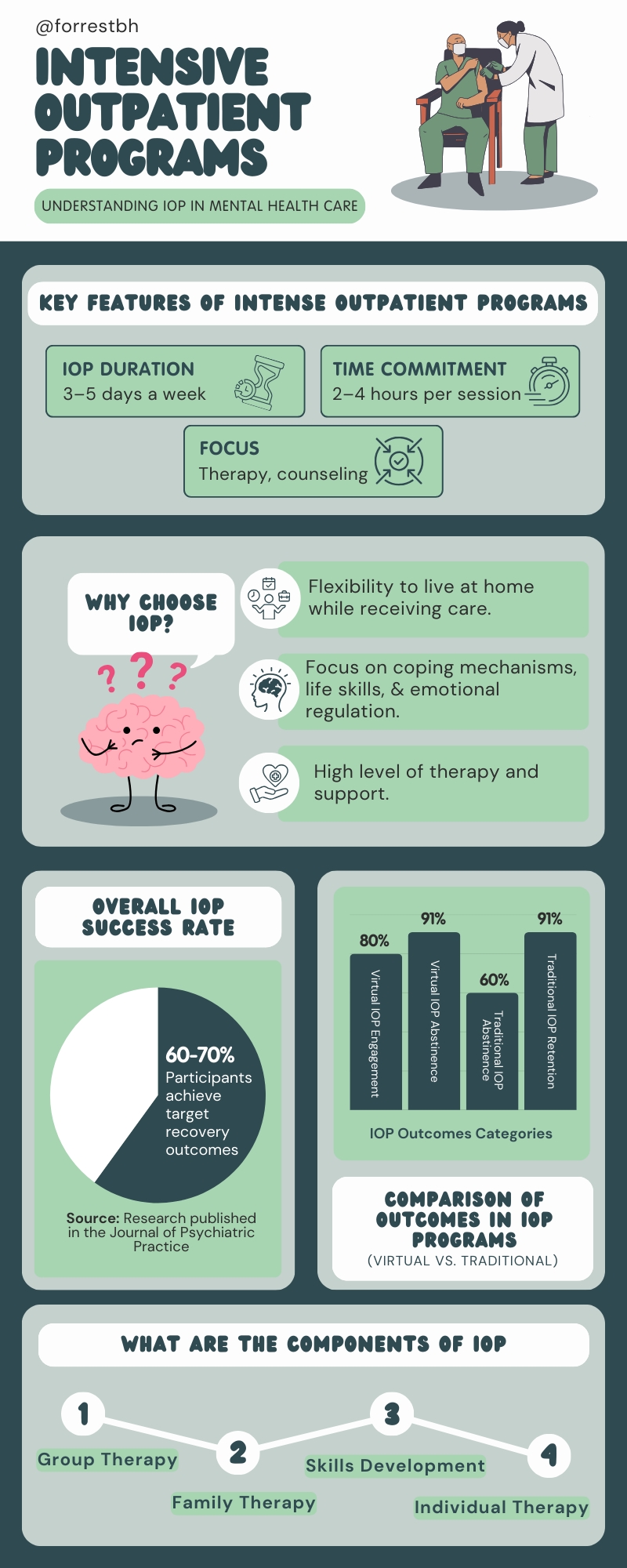
IOP programs often meet several days a week. Forrest BH describes mental health IOP sessions that may take place in the morning or evening, allowing clients to return home afterward. Still, session times differ by provider, so always ask before making plans around work.
Schedule Option | Who It May Suit | What to Ask |
Morning IOP | Night-shift workers | What time does treatment end? |
Afternoon IOP | Part-time employees | Can sessions fit around my shifts? |
Evening IOP | Full-time workers | How many evenings must I attend? |
Virtual Care | People with travel barriers | Is remote care right for me? |
Before building your work-and-treatment routine, read What Happens in a Mental Health IOP? to learn what therapy sessions and care planning may involve.
How Can You Plan IOP While Working?
Planning your week before treatment starts can remove some pressure. Think of it like preparing for a busy travel day. You would not leave for the airport without checking the time, route, and what you need to pack. IOP while working needs the same kind of thought.
- Ask for the exact weekly therapy schedule
- Block treatment hours on your calendar
- Plan meals, travel and childcare ahead of time
- Tell your care team about work conflicts early
- Protect time for sleep after evening therapy
A full schedule may still feel tiring at first. That does not mean you are doing anything wrong. It simply means you may need to adjust your routine.
How Can You Manage IOP While Working?
Work can create pressure. It can also provide structure, social contact, and a sense of purpose. The key is noticing whether your job is helping you stay grounded or pushing you past your limit.
For example, someone may manage client calls all day but feel drained by late afternoon. An evening IOP might fit their calendar. Still, their clinician may suggest fewer hours for a while if exhaustion is getting worse.
When Can Work Become Too Much During IOP?
Working during IOP may not be a good fit if symptoms affect safety or basic functioning. Frequent panic, unsafe thoughts, severe fatigue, poor sleep, or trouble getting through simple tasks can be signs that your current routine is too demanding.
Taking time away from work is not a failure. Sometimes it gives you the breathing room needed to focus on care. Your treatment team can help you discuss a schedule that makes sense for your situation.
Do You Have to Tell Your Employer About IOP Treatment?
You do not have to share every private detail with your employer. Before starting treatment, consider your workplace policy, available leave, and what information you feel comfortable discussing.
Eligible employees at covered workplaces may use Family and Medical Leave Act leave for a qualifying serious mental health condition and related treatment visits. Rules apply, so speak with your HR department or review the Department of Labor’s mental health and FMLA guidance.
You may only need to say that you have recurring medical appointments. If you need paperwork, ask your treatment provider what documentation they can provide.
What Does a Real-World IOP Study Show?
A 2020 study reviewed records from 205 adults in a community mental health program. Researchers looked at partial hospitalization, IOP-only care, and step-down treatment. The IOP-only group attended three days each week for three hours per day. Participants also received individual therapy and could access medication management when needed.
Across the study groups, participants reported lower depression, anxiety, hopelessness, and overall distress by discharge. Still, this was not a randomized trial. It cannot predict how one person will respond to treatment.
A regular IOP schedule can give you space to test coping skills at work, at home, and in everyday conversations.
How Can Massachusetts Workers Find the Right Evening IOP?
The closest program is not always the best fit. If you work in Boston, commute from a nearby community, manage rotating shifts, or care for family during the day, session times matter.
Before choosing an IOP, ask:
- Does the program offer morning, afternoon, or evening care?
- How many sessions are required each week?
- Can the schedule work around rotating shifts?
- What happens if a work conflict affects attendance?
- Does the program address mental health and substance-use concerns together?
Forrest BH offers an Intensive Outpatient Program for mental health and substance-use concerns. People facing both concerns may also explore dual diagnosis treatment. A confidential assessment can help you decide what level of care fits your current needs.
Finding a Routine That Works
Working while attending a mental health IOP can be possible, but your health comes first. The right schedule should give you room to attend therapy, rest, and manage daily responsibilities without feeling stretched too thin. Are evening sessions a better fit for your workday? Would fewer hours or medical leave give you more breathing room? Forrest Behavioral Health can help you discuss these questions in a confidential assessment. Together, you can explore an IOP schedule that fits your current needs. You do not have to choose between taking care of yourself and planning for your future. Start with one conversation today.