

Grief and Loss Counseling in Lexington, MA: Support Through Life’s Hardest Seasons
Grieving in a high-pressure community like Lexington can feel incredibly isolating. Local corporate culture often expects grieving professionals to take three days of bereavement leave and immediately return to managing demanding careers.
Recent 2026 data show that roughly ten percent of bereaved adults experience complicated grief requiring specialized clinical intervention. We must challenge the toxic myth that you can just move on. Forcing yourself to project normalcy while experiencing acute emotional pain often triggers a psychological collapse.
You do not have to carry this heavy burden alone. Located just minutes away in Bedford, Forrest Behavioral Health provides specialized grief counseling and structured outpatient programs to help you safely process your trauma and rebuild.
The Heavy Burden of “High-Functioning” Grief in Lexington, MA
The Pressure to Maintain the Status Quo
Executives and parents in Middlesex County frequently compartmentalize their emotional pain to protect their families. They force themselves to maintain a pristine public image while internally crumbling under the weight of a devastating loss.
Constant emotional suppression creates a baseline of chronic biological stress. The human nervous system simply cannot sustain that level of output indefinitely. The individual eventually becomes emotionally numb just to survive the workday.
The physical body keeps a rigid biological score of unexpressed sorrow. Ignoring the trauma forces the brain into a perpetual state of hypervigilance. Chronic grief frequently manifests somatically as unexplained tension headaches or severe digestive issues.
The Danger of Delayed and Complicated Grief
Unprocessed grief does not just disappear over time. It can mutate into more complex physiological symptoms. Your brain can store this unprocessed emotion in your muscle tissue.
Delayed grief frequently manifests months later as sudden panic attacks or chronic insomnia. A traumatized brain will eventually force you to acknowledge the loss through severe executive dysfunction. You might suddenly lose the ability to organize basic tasks or answer simple work emails.
When the central nervous system can no longer suppress the trauma, clinical depression takes root. The person loses their baseline ability to regulate basic emotions. Professional intervention becomes a medical necessity to stop the cognitive decline.
Why Time Alone Does Not Heal Complex Trauma
Moving Beyond the Outdated “Stages of Grief”
Popular culture often paints grief as a neat progression of five predictable stages. That outdated framework misrepresents the actual clinical reality of bereavement. Grief is a highly chaotic, cyclical neurobiological event.
The grieving process physically alters the emotional regulation centers of your brain. Your amygdala perceives the acute loss as an active threat to your survival. It continually floods your bloodstream with stress hormones to keep you alert.
You cannot simply wait out this neurological disruption. Repairing the damaged prefrontal cortex requires active and focused clinical intervention. We teach the brain how to establish a new emotional baseline safely.
Addressing Co-Occurring Depression and Dual Diagnosis
Many high-achieving adults turn to chemical buffers to survive acute pain. Using alcohol to force sleep or numb daily anxiety is a common but dangerous adaptation. The brain quickly relies on these central nervous system depressants to function.
Relying on chemical depressants rapidly damages the reward circuitry of the brain. Professional counseling must address both the raw grief and these emerging substance habits simultaneously. Treating the emotional wound without removing the chemical buffer leaves the nervous system vulnerable.
Dual diagnosis care ensures true healing rather than temporary symptom management. We help you build authentic distress tolerance without relying on self-medication. You learn how to navigate your sorrow with clarity and clinical support.
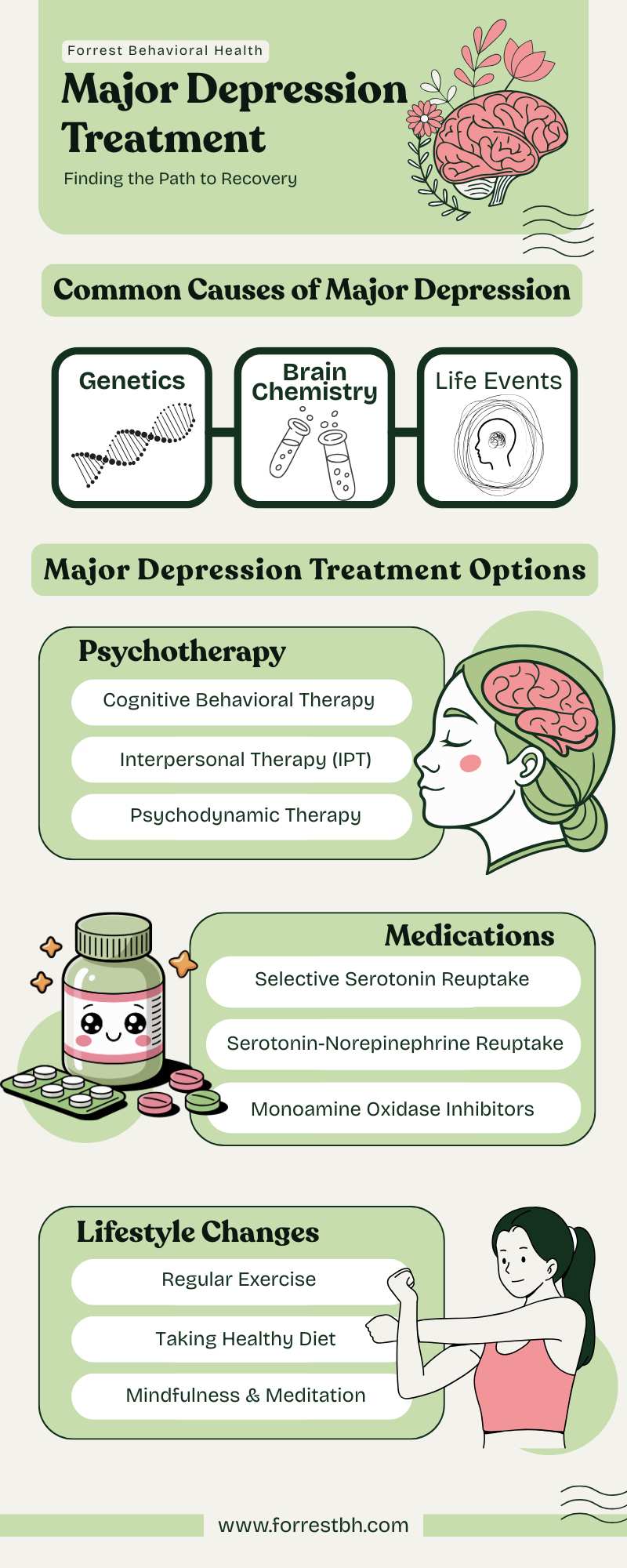
Specialized Grief and Loss Counseling at Forrest Behavioral Health
Processing Loss with Evidence-Based Modalities (EMDR, CBT, DBT)
Our master-level therapists move far beyond standard weekly talk therapy. We utilize Eye Movement Desensitization and Reprocessing to address the traumatic imagery of a sudden loss. EMDR allows the physical body to safely reprocess agonizing memories into neutral events.
We pair this somatic approach with Cognitive Behavioral Therapy to intercept destructive thought loops. CBT teaches your brain how to challenge feelings of survivor guilt logically. You regain the cognitive ability to process your grief without spiraling into panic.
Clinicians also deploy Dialectical Behavior Therapy to teach real-time emotional regulation. These tools build robust distress tolerance for navigating difficult anniversaries and upcoming milestones. You acquire a permanent clinical toolkit for long-term psychological survival.
Stepped-Up Outpatient Support (IOP & PHP) Near Lexington
Weekly therapy often fails to contain the overwhelming waves of acute grief. Our Partial Hospitalization and Intensive Outpatient Programs provide hours of robust daily clinical support. Clients receive rigorous daytime psychiatric care to safely stabilize their nervous systems.
They then return to the comfort of their own homes in Lexington every night. Protecting your natural sleep environment is biologically vital for neurological recovery. Achieving deep REM sleep allows your brain to organically process the daily trauma therapy.
Bringing those real-world evening struggles back to your therapist the next morning allows for rapid clinical adjustments. This dynamic structure provides an incredible safety net during the hardest season of your life. You heal within your actual community.
A Highly Discreet, Boutique Clinical Sanctuary
Processing deep vulnerability requires a physical environment that guarantees privacy and dignity. We intentionally designed our modern Bedford facility as a quiet clinical sanctuary. Through neuroception, your brain recognizes this calm environment and lowers its internal threat response.
We maintain small caseloads to ensure elite discretion for prominent community members. Our setting stands in stark contrast to crowded and sterile hospital environments. You never have to worry about running into colleagues in a chaotic public waiting room.
Your nervous system can finally relax and focus on authentic healing. You receive premier psychiatric attention from experts who respect your intelligence and your boundaries. We prioritize your confidentiality at every single stage of the treatment process.
Find a Safe Space to Process Your Grief Today
Seeking professional help to navigate a devastating loss is a vital act of self-care. It represents the most courageous step you can take to protect your future and your family. You must drop the exhausting mask of high functionality and allow yourself to heal.
Please reach out to our compassionate admissions directors today. We provide a confidential assessment to help determine the right level of care for your grief. Contact Forrest Behavioral Health at 4 Preston Ct, Unit 101, Bedford, MA 01730; call (781) 570-5781, or visit forrestbh.com.