
Bipolar Disorder Treatment in Reading, MA: Finding Stability Through Outpatient Care
Bipolar disorder affects about 4.4% of U.S. adults at some point in their lives, and 2.8% of U.S. adults experience bipolar disorder during any given year. Half of adults with the condition trace the start of it to their teenage years.
The news, fortunately, is better than the figures. In February 2026, the FDA approved Milsaperidone for the treatment of acute manic or mixed episodes in patients with bipolar I disorder. The University of Minnesota team received a $4.4 million grant to evaluate personalized brain stimulation for severe bipolar disorder. Scientists are working on new ways to help stabilize the mood swings. The best management at the moment is a good outpatient team near home.
Types of Bipolar Disorder
Bipolar isn’t one setting. It’s a dial with several ranges, and the range you fit in shapes your treatment.
Bipolar I Disorder
You’d have at least one episode lasting a week or more (or any length if hospitalization is needed) with elevated or irritable mood and surging energy. Sleep shrinks to a few hours, and you feel fine. Speech races. People may also lose touch with reality during severe episodes.
Bipolar II Disorder
Bipolar II pairs at least one major depressive episode with at least one hypomanic episode. Hypomania is mania’s quieter cousin: four days or more of high energy that doesn’t wreck your life. That’s exactly why people never mention it to a doctor. Don’t mistake “less intense highs” for “mild.” One study of 808 people with bipolar I and II found bipolar II to be more chronic and depression-dominant.
Cyclothymic Disorder
Cyclothymia is the long, low-grade version. For at least two years (one in teens), you cycle through hypomanic and depressive symptoms that never quite reach a full episode. Moreover, you’re rarely symptom-free for more than two months. People shrug it off as “just moody.” It can progress to bipolar I or II, so it deserves a real plan.
Outpatient Care vs. Intensive Outpatient Programs (IOP)
Traditional outpatient care usually means a weekly therapy session (sometimes every other week) plus periodic visits with a psychiatrist for medication management. It’s lighter, cheaper, and easy to fit around a job. It also assumes you can hold steady between appointments.
IOP means structure. Expect around nine or more hours a week, spread over three to five days, mixing group therapy, individual sessions, skills training, and medication oversight. It’s built for the moments when weekly care isn’t enough but a hospital isn’t necessary.
So which is better? Neither, universally. (Sorry. You were hoping for a winner.) IOP is preferred following a hospital stay, during or immediately after an episode, or when symptoms are tearing through work and relationships. Traditional outpatient is best if you’re stable and need maintenance. The smart thing to do is to regard them as stairs, not rivals: step up when things wobble, and step down when they settle.
Outpatient Benefits You Can Experience in Readings, MA
Skip the usual “flexibility” and “affordability” talk. Those are real, but they’re also the first things any provider lists. Following is what outpatient care at Forrest Behavioral Health does for people recovering from bipolar disorder in Readings, Massachusetts.
Real-World Rehearsal
The goal of inpatient treatment is to reduce stress and provide structure. There are set times for meals, lights are turned on and off on a rigid schedule, and other factors that can cause stress are reduced.
Outpatient care is not a controlled environment. You put all your learnings to use right away in your daily life.
If an intervention doesn’t work, you bring it up in your next therapy session, so your personal psychiatrist can tweak the treatment plan.
Our Clinicians Know Your Baseline
Bipolar disorder is difficult to detect early on, as the initial signs of mood changes are often positive. A great week is full of energy, less need for sleep, and a sudden confidence.
Your psychologist sees you for months on end and knows what your “normal” looks like. How fast you usually talk. How much you sleep. How you dress and spend. That history allows them to see tiny deviations from your norm.
Your Own Relapse Signature
Continued outpatient treatment gives you and your psychiatrist the opportunity to develop a personalized relapse prevention plan specific to your needs and abilities.
You also decide in advance what happens when two or three signs appear together. That plan means you’re not making big decisions in the middle of an episode.
Medication Tuned to Your Actual Life
Continued treatment allows trial and error with medication dosages, possible side effects, and regular blood tests for drugs with narrow therapeutic windows such as lithium.
You’re more likely to find a dose and type of medication that works for you when you slowly fine-tune your medication and provide your psychiatrist with regular feedback about how you’re feeling.
This is important because sudden discontinuation of medication is one of the most common reasons for bipolar relapses.
Your Identity Stays Intact
Home, work, school, and relationships provide the comfort that helps preserve what’s so easy to forget: your sense of self. You are a parent or an employee or a student who receives treatment, not a patient who occasionally leaves the hospital.
Outpatient care means your family and close friends are involved too, so they understand the illness and know what to do to help.
Psychotherapy That Builds the Skills
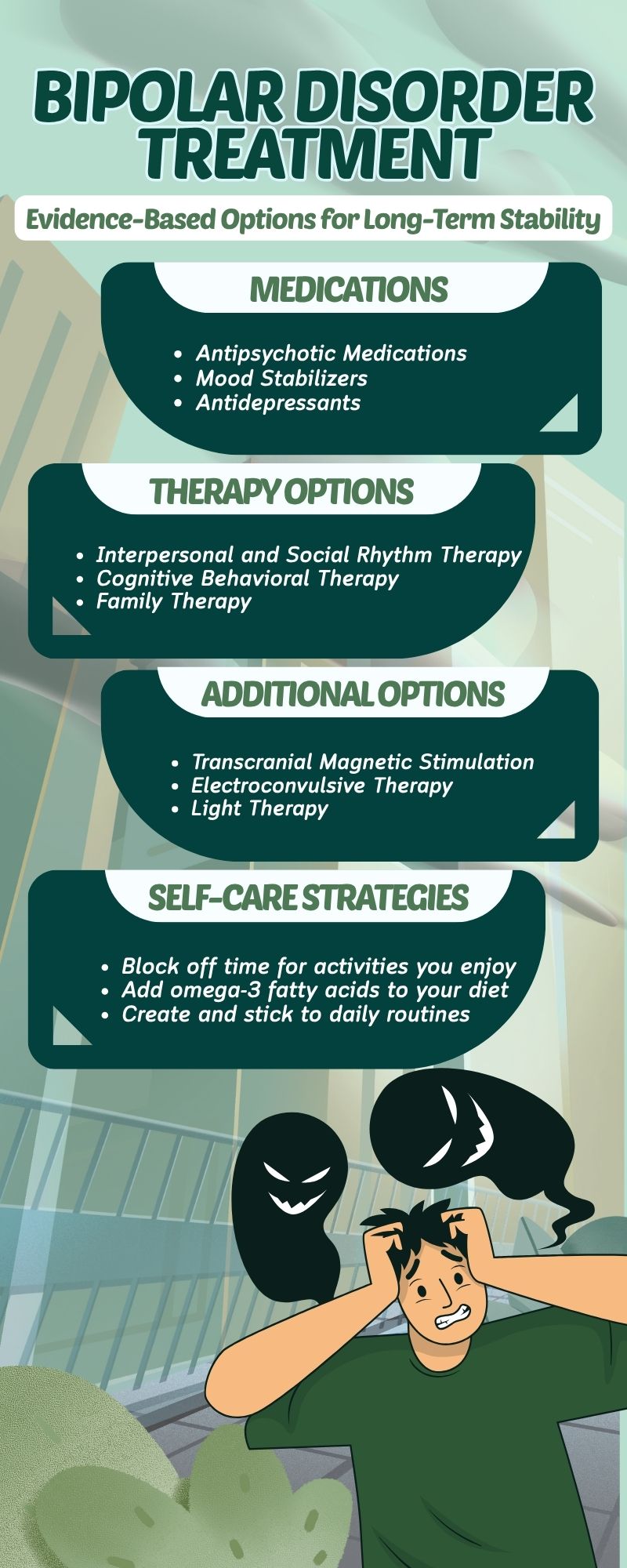
Medication stabilizes mood. Therapy teaches you how to read it. Psychosocial support with medication is recommended. Outpatient care lets you do it again and again, week after week. The typical toolkit will include:
- Psychoeducation
- Cognitive behavioral therapy (CBT)
- Interpersonal and social rhythm therapy (IPSRT)
- Family-focused therapy
- DBT-style skills
Final Words
Bipolar disorder is manageable, but it rarely manages itself. Outpatient care in Reading, MA, can help you get better without pulling you out of your life.
Start where you are. If weekly sessions are holding, keep them. If symptoms are slipping, step up to an IOP before things escalate. Either way, the first move is a conversation with a qualified provider, and the sooner you have it, the more options you’ll have.
Ready to take that step? Reach out to Forrest Behavioral Health (781) 570-5781 to talk through your options and find the level of outpatient care that fits your life.
Read Next: Does MassHealth Cover IOP? A Guide to Behavioral Health Coverage in Massachusetts