

How Long Is a Mental Health IOP Program? IOP Program Length and Schedule
“Small steps still move you forward.”
Starting treatment can feel intimidating. You may be dealing with anxiety, depression, trauma or substance use while trying to keep up with work and family.
So, how many weeks is IOP? Most mental health IOP programs last between six and 12 weeks. Your path may be shorter or longer based on your needs. In 2024, 61.5 million adults experienced mental illness, so needing help is far more common than it may seem.
This guide explains IOP program length, the intensive outpatient schedule, and what may shape your care plan.
How Long Is a Mental Health IOP Program?
A mental health IOP program often lasts six to 12 weeks. Still, there isn’t one calendar that works for every person. Think of treatment like learning to drive. Some people feel steady after a few lessons. Others need more time behind the wheel before busy roads feel manageable.
An IOP program length depends on your symptoms, progress, home life and treatment goals. Some people enter IOP after inpatient or day treatment. Others need more support than weekly counseling can offer. A clinical team reviews your needs throughout care, so the program can shift as you do.
- 6–8 weeks: May suit people stepping down from a higher level of care
- 8–12 weeks: A common range for structured mental health support
- 12–16 weeks: May help people facing trauma, dual diagnosis or more persistent symptoms
A typical IOP duration can vary by provider and personal progress. The goal isn’t to rush through treatment. It’s to leave with skills you can use when life gets bumpy.
What Does an Intensive Outpatient Schedule Look Like?
The number of weeks matters. However, the weekly time commitment matters too. Many people need treatment that works alongside jobs, school, family duties, or other real-life responsibilities.
How Many Hours Per Week Is IOP?
An intensive outpatient schedule often includes nine to 15 hours of therapy each week. Many programs meet three to five days per week, with sessions lasting around three to four hours. Forrest Behavioral Health’s Intensive Outpatient Program offers day and evening sessions that typically run three hours each. This structure gives you steady support without requiring overnight care.
Schedule Element | Typical Range | What It May Look Like |
Days each week | 3–5 days | Treatment often meets on set weekdays |
Hours each week | 9–15 hours | More contact than standard weekly therapy |
Session length | 3–4 hours | Timing varies based on clinical needs |
Location | Outpatient setting | You return home after programming |
Programs may offer daytime, evening, or mixed schedules. Ask about those options early, especially if you work shifts or care for children. IOP shouldn’t add needless chaos to an already full plate.
What Happens During IOP Sessions?
IOP sessions give you time to understand what you’re feeling and practice new responses. You may meet with a therapist one-on-one, join a group, or learn coping tools that fit everyday stress. One person may practice handling panic before work. Another may learn how to pause before reacting during an argument.
Common parts of mental health IOP include:
- Group therapy: Share experiences and learn from others in a guided setting
- Individual counseling: Discuss personal goals, symptoms, and barriers
- Skills practice: Build tools for emotional regulation, stress, and relationships
- Psychoeducation: Learn how mental health symptoms can affect daily decisions
- Medication support: Discuss treatment options when clinically appropriate
- Family sessions: Include loved ones when it supports your care goals
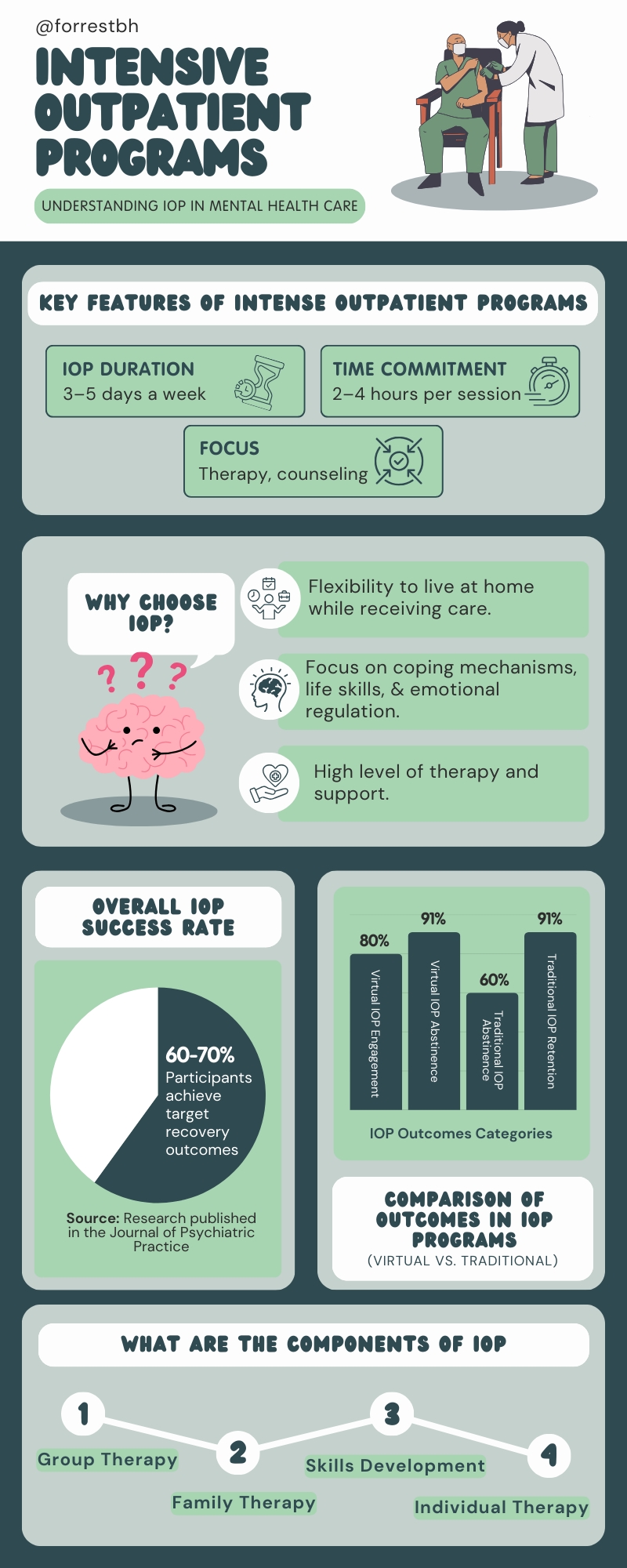
Forrest BH also provides individual counseling, group therapy, and treatment options for people with mental health and substance-use concerns.
What Can Change Your IOP Program Length?
Treatment does not follow a stopwatch. A good mental health IOP program responds to how you’re doing rather than forcing you into a fixed timeline.
Are Your Symptoms Affecting Your Treatment Timeline?
They can. Someone managing mild anxiety may need a different level of support than someone facing severe depression, trauma symptoms, mood changes, or substance use at the same time. Co-occurring conditions can make daily life feel heavier, so care may take longer.
A diagnosis alone does not decide your timeline. Your treatment team looks at how symptoms affect sleep, work, relationships, safety, and your ability to use coping skills outside sessions. People facing both substance use and mental health concerns may benefit from dual diagnosis treatment that addresses both at once.
How Does Progress Affect How Many Weeks IOP Takes?
Progress is rarely a straight line. You may feel better for two weeks, then hit a rough patch after a stressful family call or hard day at work. That doesn’t mean treatment has failed. It means you’re human.
During IOP, clinicians may review your attendance, symptom changes, coping skills, home support, and comfort using new tools independently. Based on those conversations, they may recommend stepping down to outpatient therapy or staying in IOP longer. The right pace is the one that supports steady progress.
A Documented Example of Intensive Outpatient Care
A 2025 study looked at an integrated intensive outpatient program in western Sweden. The program ran for four months and supported people with substance-use concerns. Researchers reported that 117 people began treatment between 2015 and 2021. Of those participants, 65 completed an anonymous satisfaction survey.
Among people who completed the survey, average satisfaction scores ranged from 9.17 to 9.35 out of 10. Still, the study had a high dropout rate. That means the results cannot predict what every person will experience. The study does show one useful point: IOP timelines can differ greatly, and longer care is not a sign that someone is doing poorly. Read the full study.pmc.ncbi.nlm.nih
What This Means: A longer treatment plan may give you more time to practice skills, build support, and prepare for less structured care.
Take the Next Step at Your Pace
Most mental health IOP programs last six to 12 weeks. Yet your IOP program length should reflect your symptoms, goals, progress, and support system. The schedule may feel demanding at first but it can also create space to heal without putting life completely on hold. If you are looking for mental health or dual diagnosis care in Massachusetts, Forrest Behavioral Health can help you explore the next step.
Not sure where to begin? Read our guide, How to Find the Right Mental Health Treatment Program Near You, for practical questions to ask before choosing care.