

Mental Health Treatment for Busy Professionals in Illinois
Studies prove that almost 23.4% of adults in the US face mental health struggles – that’s almost 60 million people. Notably, a majority of these people don’t receive treatment because their condition is either undiagnosed or they don’t have the resources (time, money, support).
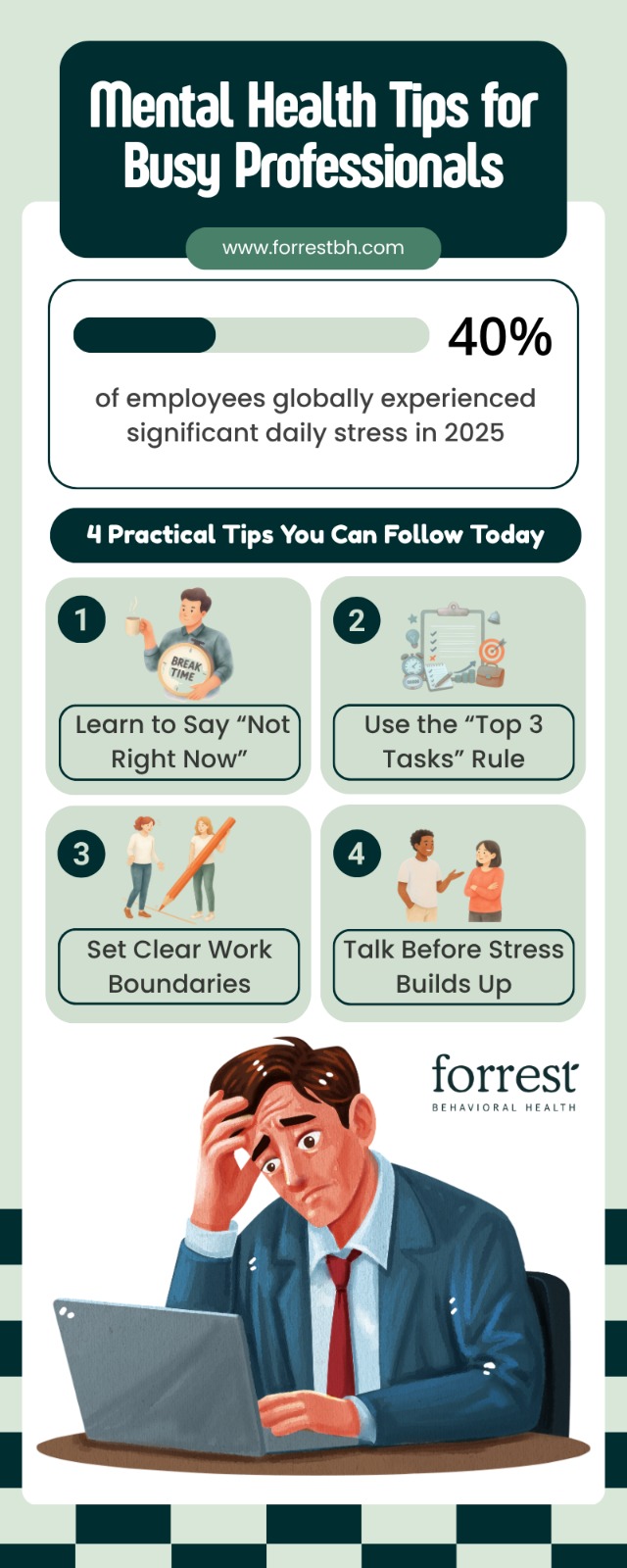
Also, because of our world’s competitive nature, busy professionals are least likely to actively seek mental health treatment. They don’t want to risk their big positions and chances of progress, so they just push through. What they might not realize is that there are mental health treatment models that can accommodate their demanding work life and other responsibilities.
Today, we’ll discuss why mental health treatment is extra difficult for busy professionals and the available options they can avail. Keep reading to not let things spiral.
Why is Accessing Mental Health Treatment Difficult for Professionals?
One might think the only reason busy professionals don’t receive mental health treatment is that they don’t have the time to attend sessions or get admitted. While it’s true to a great extent, here are some more reasons that hinder these people’s treatment:
- Lack of confidentiality
- Damaging their authority and judgment
- Appearing weak or lacking leadership
- Assuming it’s only work stress
- Not having meaningful conversations regularly
When these factors combine, someone apparently very sorted can get blindsided and not fix what’s bothering them. However, now even employers are being more considerate about mental health, and people take days off when they’re not at their best mentally. That said, this one thing makes us proud at Forrest Behavioral Health because people don’t bottle up their troubles anymore.
Ways for Busy Professionals to Get Mental Health Treatment
It’s a no-brainer that someone with a demanding and tiring work life would want a practical treatment model that doesn’t isolate them. Lucky for them, multiple options match this criteria, and here they are:
Weekly Therapy (Individual Sessions)
The easiest option to start working on your mental health while leading a busy life is weekly therapy. Meeting with a licensed therapist for 1 hour each week gives you clarity about certain feelings and emotions. Notably, these conversations are private, and the therapist is entirely focused on your current battle, be it anxiety, depression, extreme burnout, or anhedonia.
Most people take therapy for 3-6 months, but its exact duration depends on your situation and goals. For example, if you wish to continue meeting with the therapist even after the standard 6-month period, you can. In fact, many people take therapy for years if they develop a level of trust with the therapist.
When a professional has a packed schedule, this model works because the time commitment is manageable. One hour a week is workable without it bleeding into work time, and since therapy sessions can be booked early morning, during lunch, or after hours, it’s ideal when you cannot commit a lot of time.
Intensive Outpatient Program (IOP)
An Intensive Outpatient Program (IOP) is a more structured mental health treatment than weekly therapy. During this, you attend therapy sessions multiple times a week without being admitted to a treatment center. You’ll likely visit a facility 3-5 days per week for 3-hour sessions for up to 12 weeks. This is surely more restrictive, but if your mental health needs more than talk therapy, but you still don’t want to get admitted, this is where you’ll heal the best.
And despite it being a structured model, your life won’t stop – you can complete treatment while giving full hours to work.
Discussing your problems and receiving proven therapies three days a week creates a frequency that builds real momentum. Eventually, you learn to process emotions and apply new grounding techniques to remain calm in stressful situations.
Teletherapy
When every other thing is digitized, how can mental health treatment not be? During teletherapy, you have a meeting with an expert, just like the in-person weekly therapy we discussed above.
Sure, it’ll feel less personal and more isolating, but if you absolutely cannot make time for regular visits, something is better than nothing.
There is no commute, and you won’t have to block time for travel. Instead, you can join a meeting with your friendly mental health expert and discuss how things are going.
It’s worth mentioning that teletherapy works and its outcomes are comparable to in-person sessions across most mental health conditions. Busy professionals respond well to this model because it fits inside an existing routine without disrupting it.
Medication Management with Psychiatry
When a psychiatrist assesses your mental health and prescribes meds to treat your symptoms, it’s simply called medication management for mental health. Your first appointment with the psychiatrist will be long, up to 90 minutes, and after that, you’ll have follow-ups for 30 minutes every 4-12 weeks.
If a busy professional is facing a serious mental health condition, such as bipolar disorder or PTSD, therapy alone doesn’t suffice. And since time commitment is still an issue, experts follow this route where medicines are a part of the plan. Not to mention the time asked in this model is minimal compared to every other model on this list.
Retreat Programs
Don’t confuse a mental health retreat with a recreational one – this one is exclusively for treatment purposes. If a treatment center offers this facility, you’ll step away from your routine for 2 to 5 days to focus on getting better. Since this is a high-end model (with a higher cost), you get therapists, treatment sessions, and clinical support all in one place.
Professionals who cannot commit to weekly therapy for months find this model practical. A long weekend is manageable, and you experience focused progress in that time, which would otherwise take weeks.
There’s Always Something for Your Particular Situation
Whether you’re extremely busy at work or have too many family responsibilities, you can still make time for mental health treatment. That’s because easier models exist. So when you’re ready to turn your life around for the better, reach out to Forrest Behavioral Health and let’s plan to get you out of this chaos.