
Stepping Down from Inpatient or PHP to IOP: A Continuum of Care Guide for Tewksbury, MA Residents
Finishing a residential program or graduating from a Partial Hospitalization Program (PHP) is a major milestone for Tewksbury professionals. Still, going straight back to an unstructured home and a packed work calendar can feel frightening. In 2026, clinical data revealed that over 35% of patients who skip step-down outpatient care experience a relapse or hospital readmission within 90 days of discharge.
Completing acute care means your immediate crisis has been stabilized. The work of staying well in everyday life is still ahead of you. So, dropping straight to one therapy session a week can leave a risky gap in your care. Just a short drive away in Bedford, the Intensive Outpatient Program (IOP) at Forrest Behavioral Health gives you the structure you need to test your new coping skills in the real world. Let’s look at why this transition is so delicate and how an IOP helps.
Why Is the Transition Home So Risky?
Life Inside the “Treatment Bubble” vs. Real-World Triggers
Inpatient facilities and full-day programs are designed to give you a protected space. Stepping away from daily obligations gives your nervous system a chance to settle and your stress hormones a chance to come down. However, that same protection also keeps you away from the stressors that helped trigger your crisis in the first place.
Coming home to Tewksbury means facing difficult workplace dynamics, long commutes on I-495, and family conflict again. The problem is that the brain links certain places and routines with past stress or substance use. Walking back into your office or driving past familiar spots can set off your amygdala’s threat response almost immediately.
Without ongoing clinical support, those familiar cues can overwhelm your nervous system before the logical part of your brain catches up. That is why practicing your emotional regulation tools while a clinical team is still in your corner matters so much.
Why Do Abrupt Discharges Hit Executive Function So Hard?
Going from 24-hour residential supervision, or 25 hours of therapy a week, to no daytime structure at all is a big shock to the system. While your executive function is still recovering, your brain leans heavily on predictable outside structure. Losing that support overnight leaves a tired prefrontal cortex trying to juggle complicated daily logistics on its own.
When everything hits at once, working memory and task initiation are usually the first skills to slip. Many high-achieving professionals freeze when they face a flooded inbox and a pile of household responsibilities. Trying to hide that struggle from colleagues only adds to the exhaustion.
A worn-out brain looks for quick relief. Thus, without a structured step-down plan, professionals become much more vulnerable to self-medicating sudden panic with evening drinking or unprescribed stimulants.
Understanding the Continuum of Care: Where Does an IOP Fit?
What Is a “Step-Down” Level of Care?
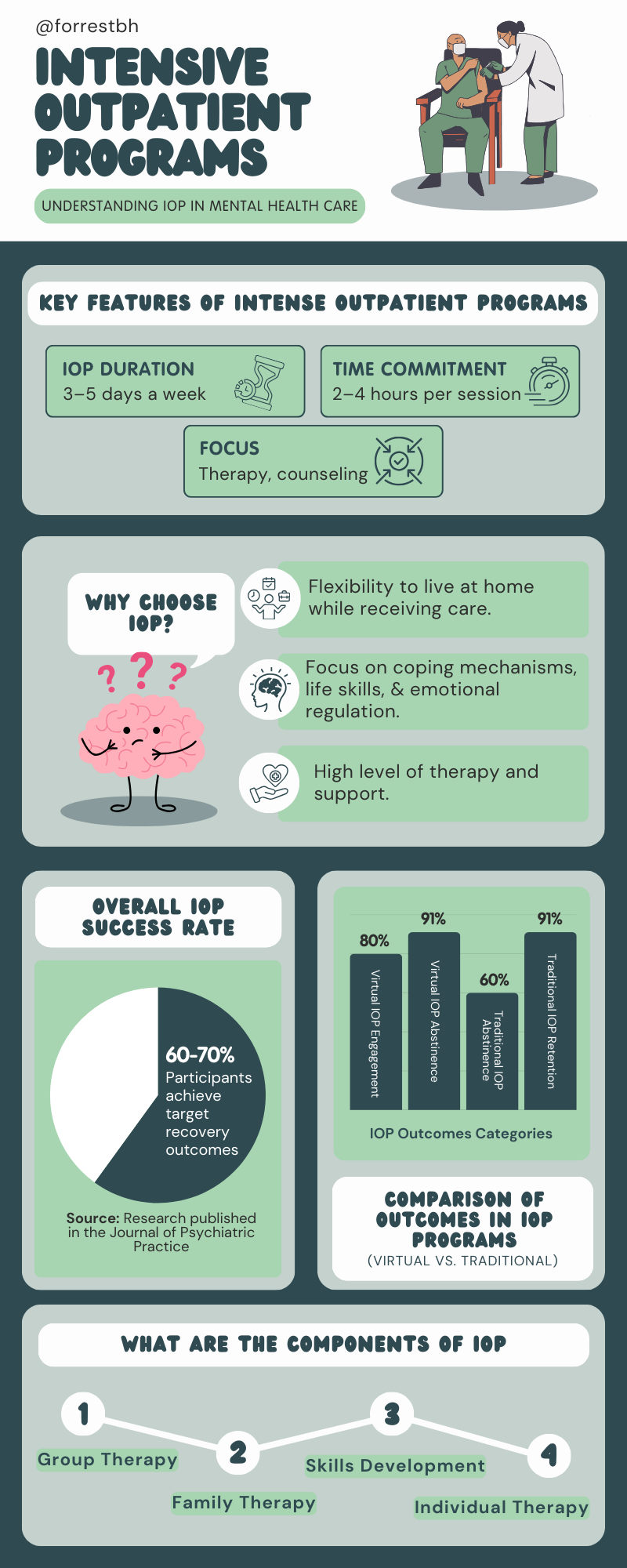
Behavioral healthcare works best as a continuum, where clinical support gradually decreases as your own resilience grows. Stepping down into an IOP bridges the gap between acute care and fully independent living. An IOP removes the clinical structure step by step, at a pace your nervous system can handle.
At Forrest, IOP means therapy 3 to 5 days a week for about 3 hours per session, with daytime and evening options. That steady level of care keeps your recovery grounded while you rebuild your independence. Meanwhile, regular sessions give you repeated practice, which helps your new coping skills hold up under real-world pressure.
Balancing Consistent Care With Career Flexibility
For many professionals, an IOP is one of the most practical ways to return to work without losing momentum in recovery. Our flexible schedule in Bedford, a straightforward drive from Tewksbury via I-495 and Route 3, lets you get back to the office, manage your household, and reconnect with your family. You receive dedicated clinical and psychiatric support during scheduled sessions while keeping your career moving.
Sleeping at home every night protects your natural circadian rhythm. Getting restorative REM sleep supports memory and helps you process the emotional stress of each day. You rebuild your independence in your own community while staying connected to an experienced clinical team for ongoing accountability.
What Does the IOP Experience at Forrest BH Look Like?
Using CBT and DBT Skills in Real Time
Our licensed clinicians treat therapy as active training for daily life. We use Cognitive Behavioral Therapy (CBT) and Dialectical Behavior Therapy (DBT) as practical tools for handling pressure at work and at home. If a tense negotiation or a family argument throws you off one day, you bring that exact situation to your next IOP session.
Working through real stressors right away lets your clinical team help you adjust your coping strategies before an emotional spike turns into a crisis. CBT trains your prefrontal cortex to break down catastrophic thought loops logically. Meanwhile, DBT gives you grounding techniques that can help calm your vagus nerve and bring your heart rate down during high-stakes moments at work.
Ongoing Psychiatric and Dual Diagnosis Support
Medical continuity is an important safeguard as you leave inpatient or full-day care. Medications that were started in a protected treatment setting often need adjusting once you are back under the stress of a normal workload, because your symptoms and daily demands change.
Our in-house psychiatric providers work closely with your therapists and check in on how your medications are working. We also help you continue Medication-Assisted Treatment (MAT) and psychiatric prescriptions without interruption, so gaps in medication access are much less likely. Through our dual diagnosis approach, we treat co-occurring anxiety, depression, and substance use together, which lowers your risk of relapse during this vulnerable stretch.
Discretion and Care Coordination for Professionals
High-achieving professionals need a clinical setting that protects their privacy and respects their schedules. Our boutique Bedford facility follows HIPAA privacy requirements and offers a quiet, private space far from crowded hospital wards. You work through recovery alongside other driven professionals who understand the pressures of the Massachusetts business world.
Our admissions and clinical teams also take care of much of the paperwork that comes with your transition. We coordinate directly with your discharging facility or PHP case manager to help make the handover of medical records and treatment plans as smooth as possible. That way, you can put your energy into staying well.
Secure Your Clinical Safety Net and Reclaim Your Life Today
You have already done the hardest part by getting through your initial crisis. Stepping down into an IOP gives that hard work the best chance of carrying over into your emotional health and your career.
Please reach out to the discreet executive admissions team at Forrest Behavioral Health today, or have your discharging case manager contact us directly. We offer coordinated intake and a fast Verification of Benefits to map out your commercial insurance coverage before you leave your current facility.
Contact Forrest Behavioral Health at 4 Preston Ct, Unit 101, Bedford, MA 01730 by calling (781) 570-5781 or visiting forrestbh.com.
Read Next: How an Intensive Outpatient Program Helps Young Adults Transitioning After College in Reading, MA